
Renesanses Cassone Koka Lāde ar Putti Kokgriezumiem un Needlepoint Gobelēnu — Neo-Renesanse, Itālija, 19.gs. (287)
Renesanses Cassone Koka Lāde ar Putti Kokgriezumiem un Needlepoint Gobelēnu — Neo-Renesanse, Itālija, 19.gs. (287)
€1,500.00
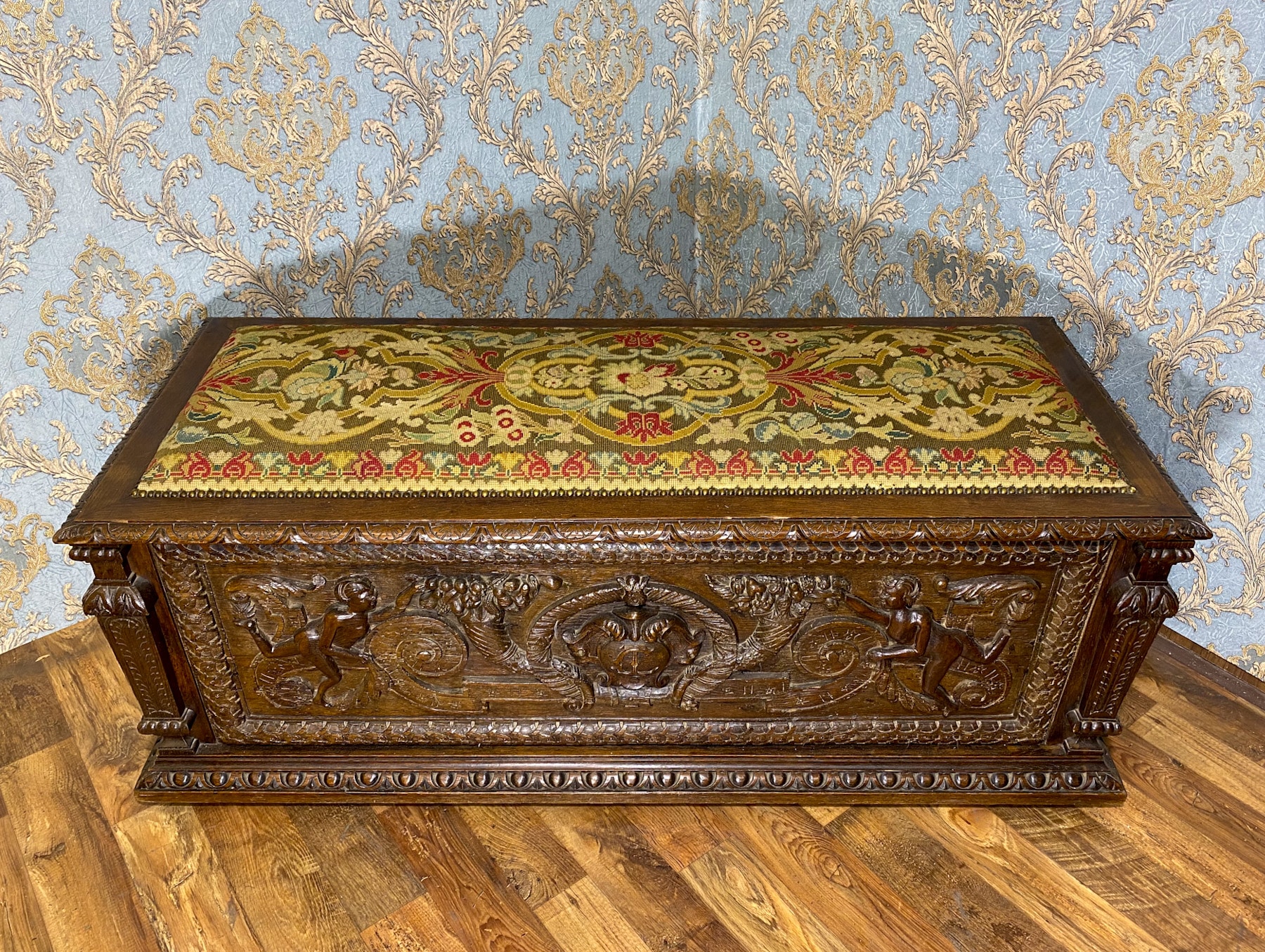
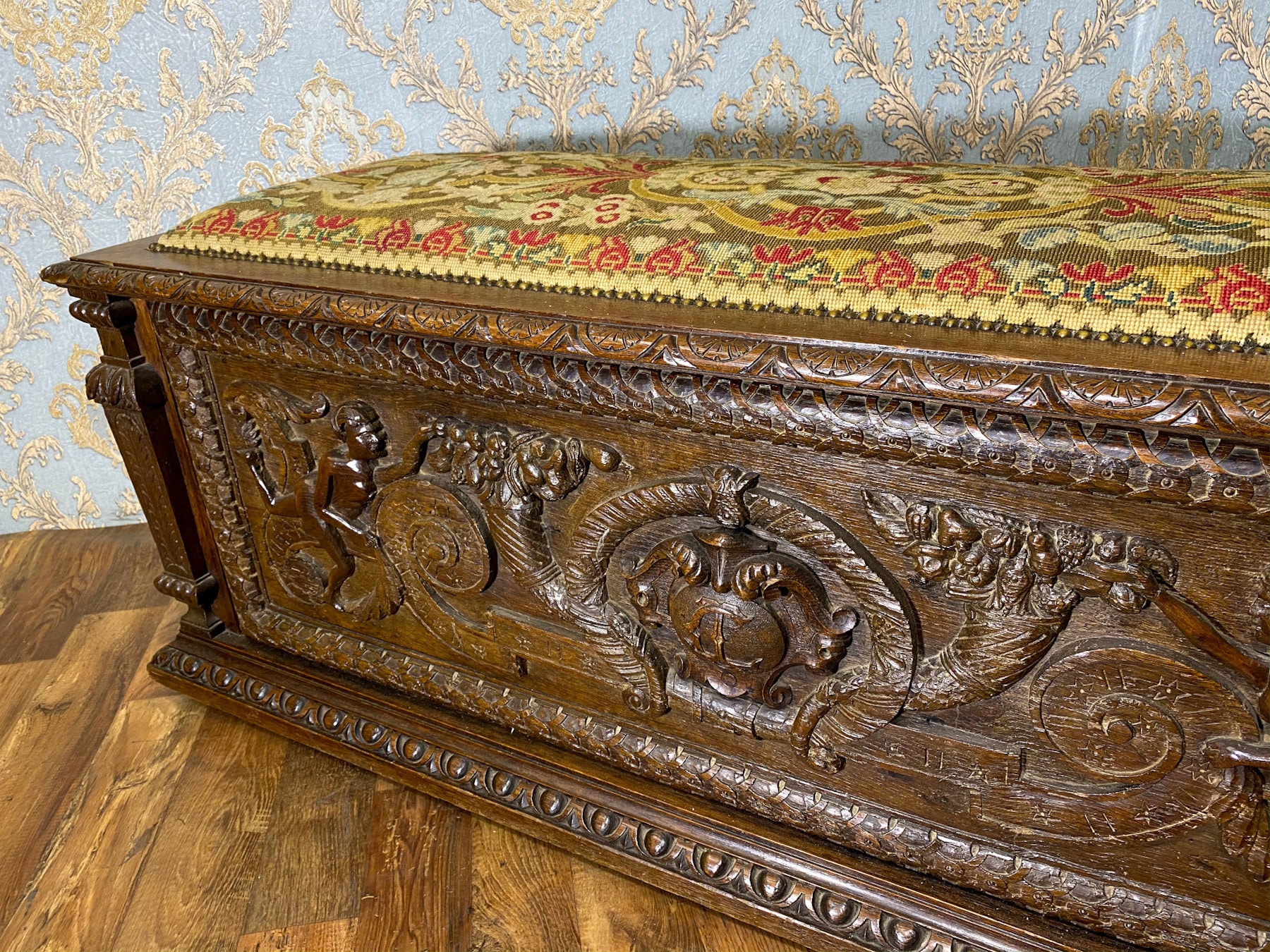
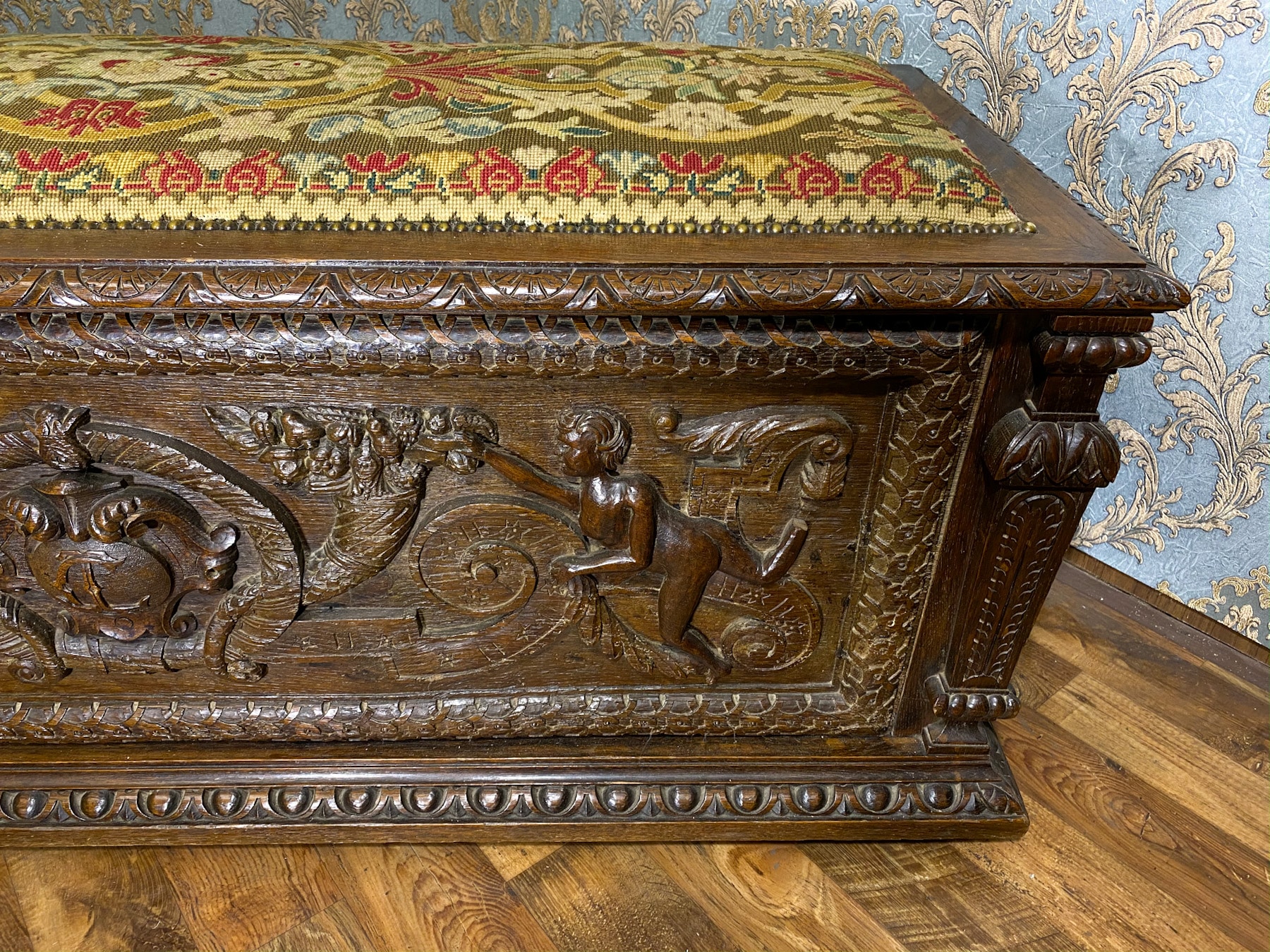
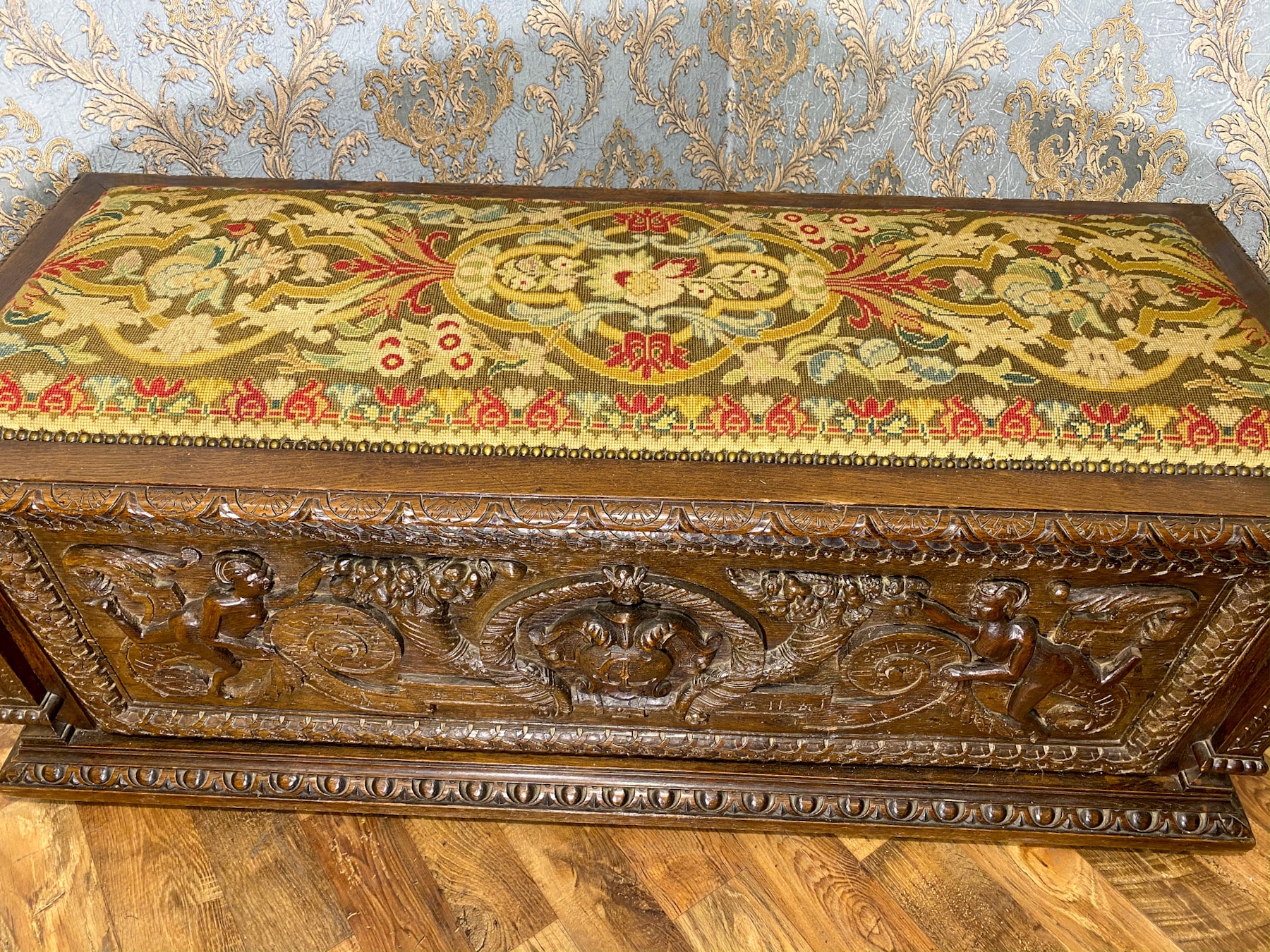
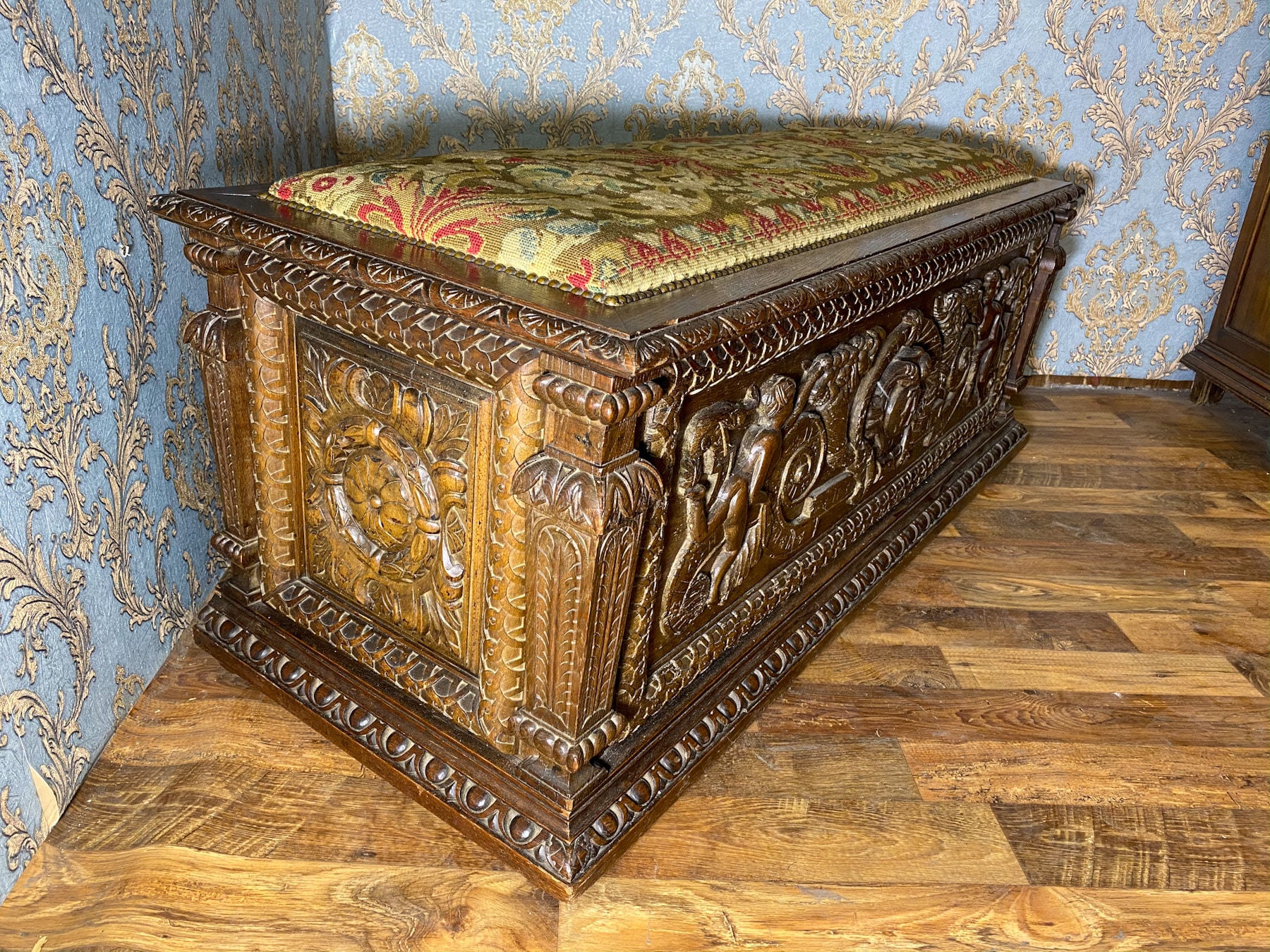
Monumentāla Neo-Renesanses cassone lāde ar figurāliem putti kokgriezumiem, trophée d’armes centrālo kartušu, pilaster sānu paneļiem un oriģinālu needlepoint gobelēna virspusi. Itālija vai Francija, ap 1860.–1890. Garums 150 cm, augstums 60 cm, dziļums 61 cm.
📐 IZMĒRI
Garums: 150 cm × Augstums: 60 cm × Dziļums: 61 cm. Svars: ļoti smags (masīvs koks).
―――――――――――――――――――――
Renesanses Cassone Lāde ar Figurāliem Kokgriezumiem un Gobelenadatu Virspusi — Neo-Renesanse / Historicisms, Itālija vai Francija, ap 1860.–1890.
―――――――――――――――――――――
IZGATAVOŠANAS PERIODS, MĀKSLAS STILS, LAIKMETS
Šī monumentālā lāde ir izcils Neo-Renesanses stila paraugs Historicisma laikmetā — periods, kad 19. gadsimta Eiropas meistari ar entuziasmu atgriezās pie itāļu Renesanses cassone tradīcijas, reproducējot 15.–16. gadsimta Florences un Venēcijas kāzu lāžu formas ar visu industriālā laikmeta amatnieciskās precizitātes iespējām. Cassone — itāļu Renesanses kāzu lāde — bija viena no nozīmīgākajām mēbelēm aristokrātu un augstās buržuāzijas mājsaimniecībās, un tās kokgriezumi stāstīja mitoloģiskas un vēsturiskas ainas.
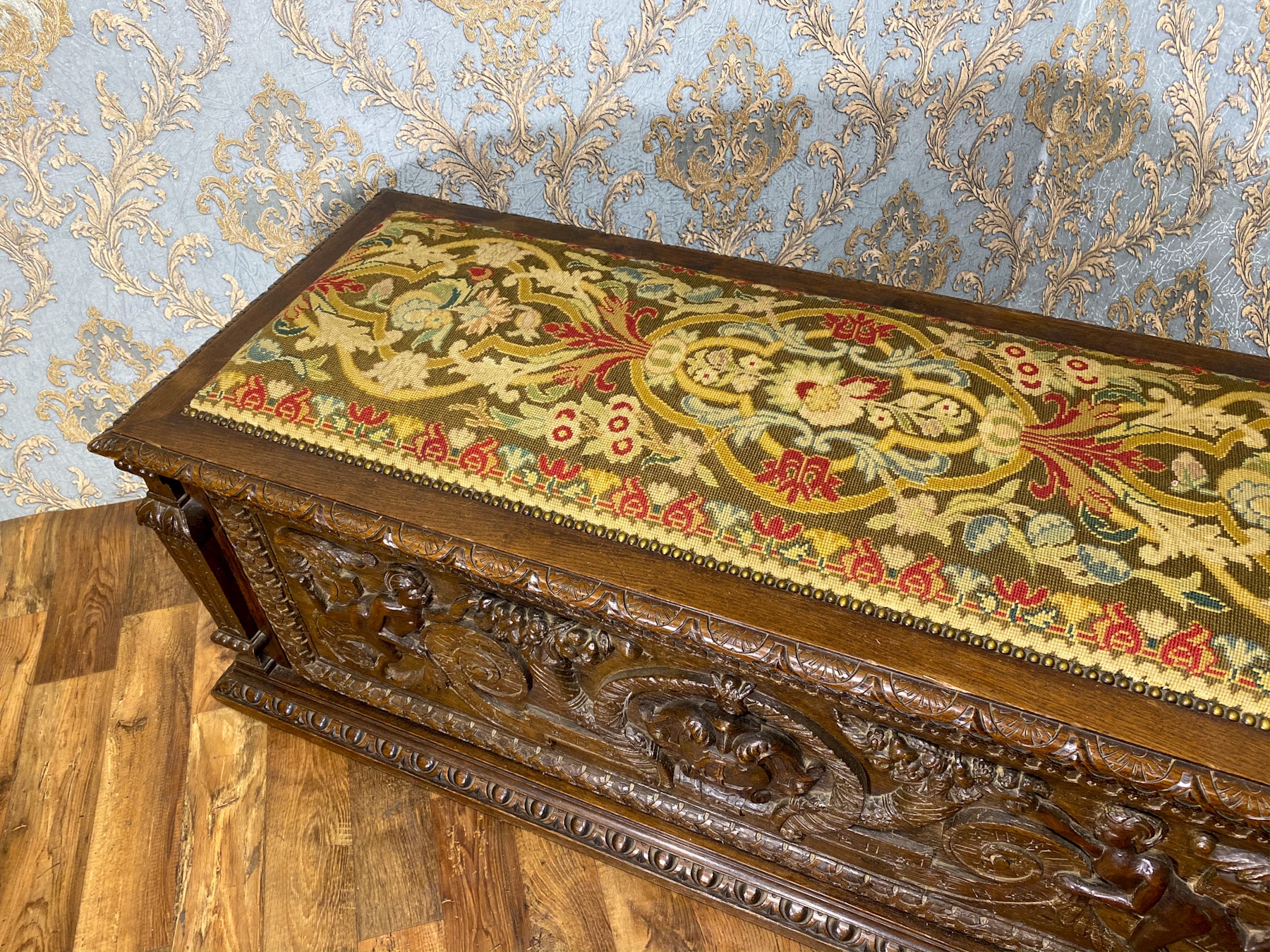
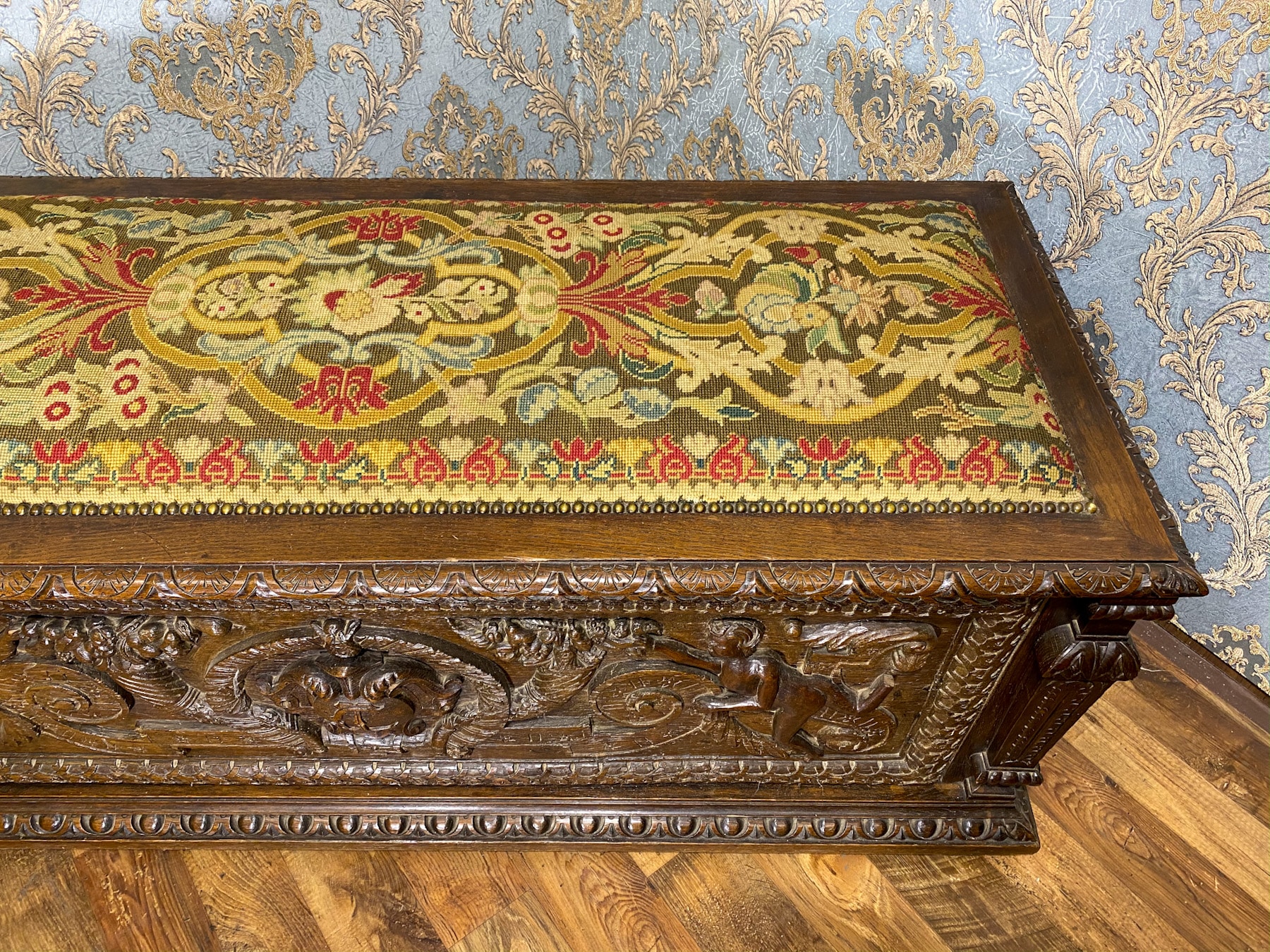
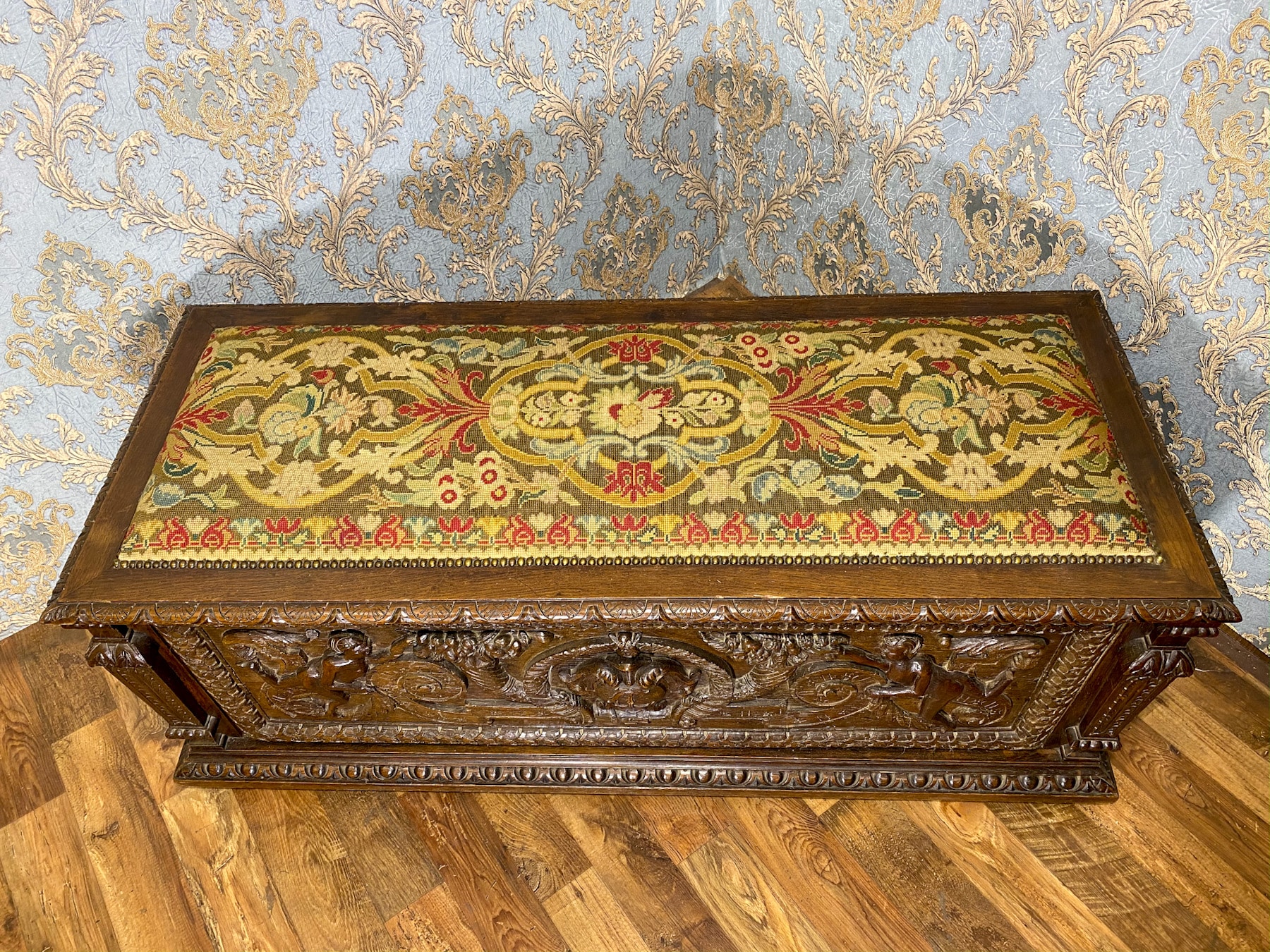
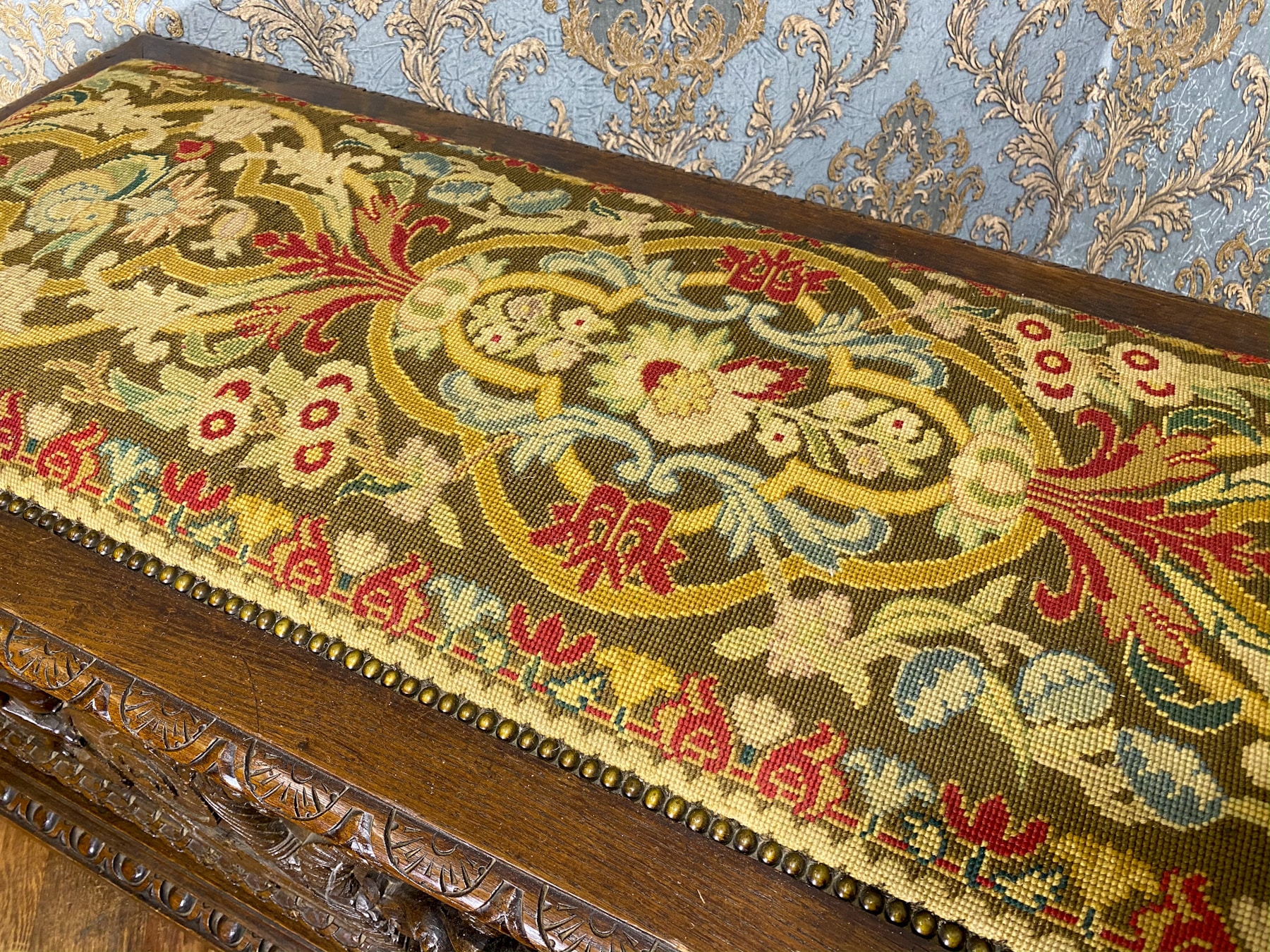
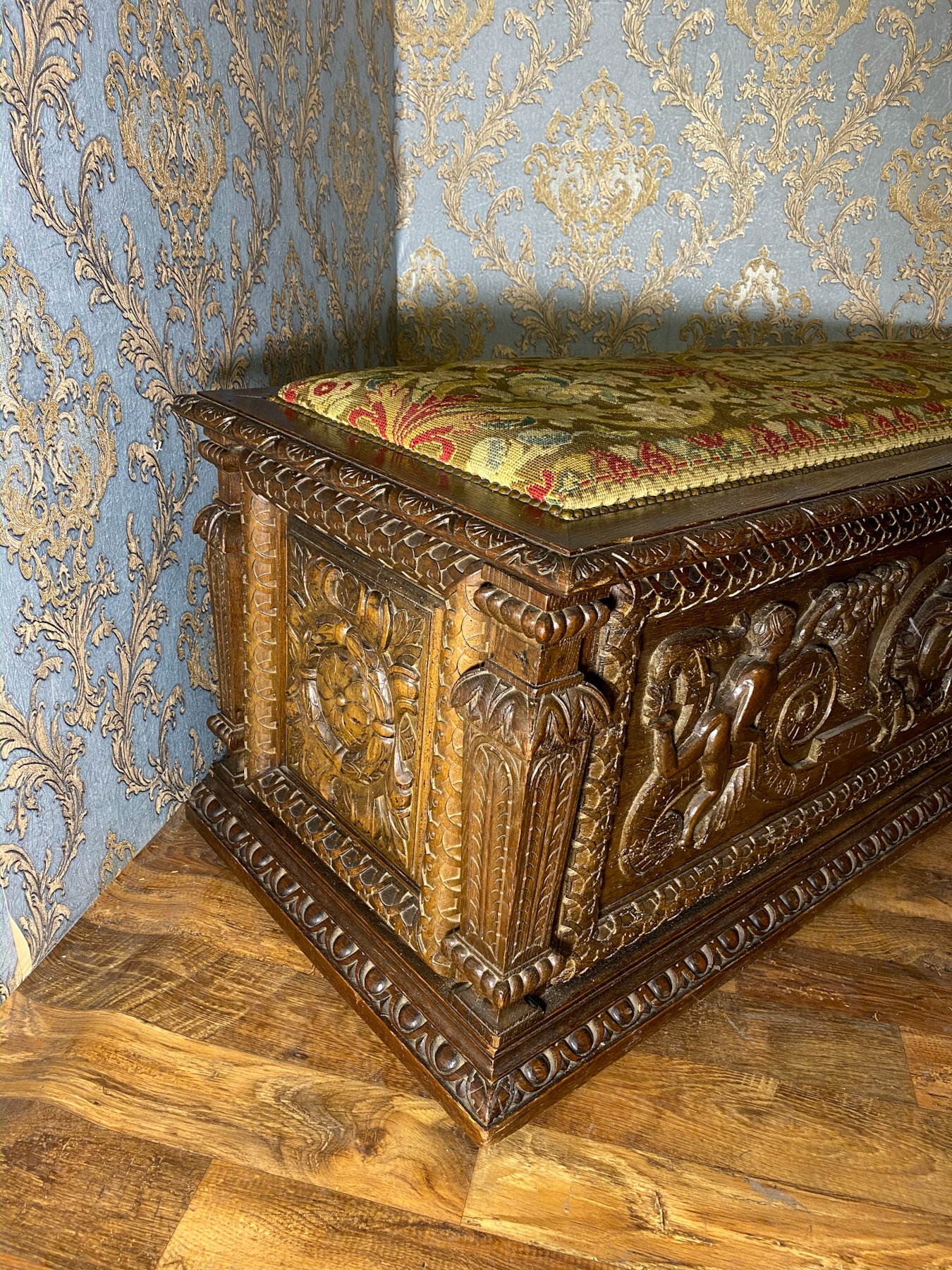
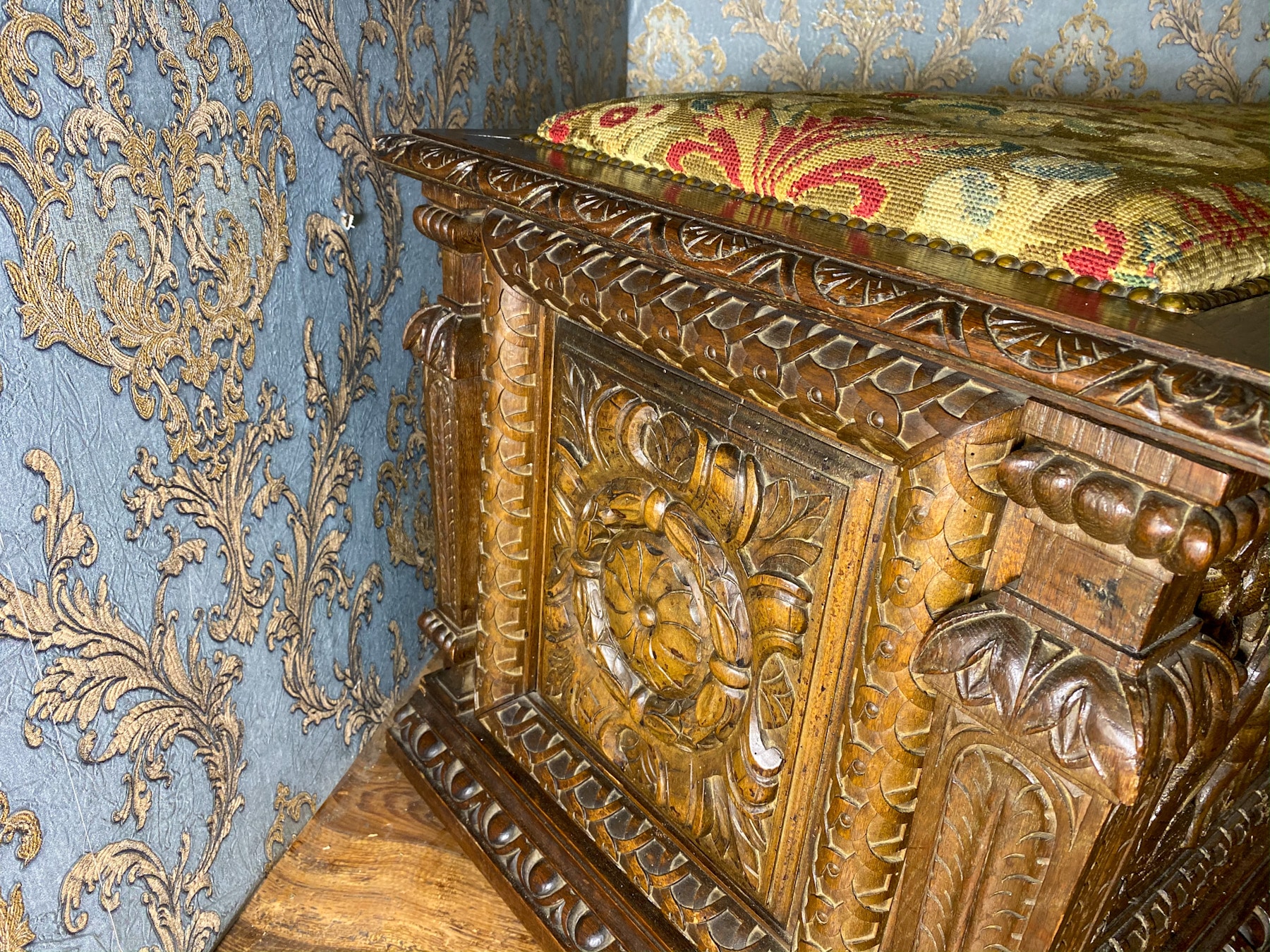
Fasādes centrālo paneļu kompozīcija ir izņēmuma mākslinieciskā līmenī: divi simetriski putti — kailīši bērni ar vairogiem un trofeju girlandēm — flankē centrālo cartouche ar ķiveri, bruņām un lauru zaru trophée d’armes kompozīciju. Šī ikonografija tieši atsaucas uz Renesanses triumfa un slavas tēmām. Sānu paneļi rotāti ar rosette un pilaster motīviem — arhitektonisks elements, kas raksturīgs tieši itāļu Renesanses mēbelēs. Augšējā un apakšējā frize — ar egg-and-dart un bead-and-reel profiliem — klasiskās antīkās arhitektūras detaļas. Gobelēna virspuse — ar sarkaniem, zaļiem un zeltu toņiem florālā arabesku rakstā — izskatās pēc rokdarbu needlepoint izšuvuma, kas stilistiski atbilst Viktorijas laikmeta vai Arts & Crafts tradīcijai, un ir nostiprināta ar zeltītām misiņa naglām.
Šī lāde datējama 1860.–1890. periodā — Belle Époque laikmetā, kad Neo-Renesanses stils bija viens no dominējošajiem Historicisma izpausmju veidiem Eiropas interjeru mākslā.
Belle Époque momentuzņēmums: 1869. gadā Pariolo kvartāla jaunās villas Romā tika iekārtotas tieši ar šāda veida cassone lādēm — Neo-Renesanses estētika bija ne tikai mode, bet nacionālās identitātes izpausme jaunvienotajā Itālijā. Tajā pašā gadā Eugène Viollet-le-Duc Parīzē publicēja savu lekciju sēriju par viduslaiku un Renesanses mēbelēm, iedvesmojot paaudzi galdnieku un kolekcionāru visā Eiropā. Šī lāde varētu būt tapusi tieši šajā Renesanses nostalģijas augstākā viļņa brīdī.
―――――――――――――――――――――
RAŽOTĀJS UN MANUFAKTŪRAS ZĪMOGS
Redzama marķējuma nav. Pēc putti figūru plastiskuma, trophée d’armes kompozīcijas izsmalcinātības un sānu pilaster arhitektoniskā risinājuma — iespējamā izcelsme Itālija (Toskāna vai Venēcija) vai Francija, kur Neo-Renesanses mēbeļu ražošana 19. gadsimta otrajā pusē sasniedza augstu māksliniecisko līmeni. Itālijā šāda veida cassone atkārtojumus ražoja Florences un Sienas augstākās klases galdnieki, bieži vien tieši pēc muzeju oriģinālu mērījumiem. Gobelēna needlepoint virspuse — ar tās arabesku rakstu un krāsu gamma — var norādīt uz Angliju vai Beļģiju kā tekstila izcelsmi.
―――――――――――――――――――――
RETUMS UN NOZĪME
Monumentāla Neo-Renesanses cassone lāde ar figurāliem putti kokgriezumiem, trophée d’armes centrālo kompozīciju un oriģinālu needlepoint gobelēna virspusi šādā izmērā un saglabāšanās stāvoklī ir ārkārtīgi reta parādība. Lielākā daļa saglabājušos cassone lāžu ir vai nu bez virspuses tekstila, vai ar bojātu fasādes kokgriezumu. Šīs lādes neskartums — gan kokgriezumi, gan gobelēns — padara to par muzeja kvalitātes kolekcijas lietu. Antikvāru pasaulē cassone ar figurāliem kokgriezumiem un oriģinālu tekstilu pieder augstākās pieprasījuma kategorijai.
―――――――――――――――――――――
PIELIETOJUMS INTERJERĀ, DIZAINĀ UN FOTOGRĀFIJĀ
Šī lāde ir radīta reprezentatīviem priekšnama, bibliotēkas, salona vai studijas interjeriem. Tās gobelēna virspuse ļauj to izmantot kā ottomane vai soliņu — funkcionāli un estētiski vienlaikus. Sader ar Neo-Renesanses, Neobaroka, eklektisko un grand manor interjeru. Interjeru fotogrāfijā — nepārprotams itāļu Renesanses vai viktorianisma aristokrātu rezidences akcents. Mūsdienu maximalist un dark academia interjerā tā ir kulminācijas elements.
―――――――――――――――――――――
DĀVANA UN PERSONALIZĀCIJA
Šī lāde ir izcila reprezentatīva iegāde augstākā līmeņa kolekcijām, bibliotēkām, pils stila rezidencēm un mākslas pazinējiem. Kā personīga dāvana — vēsturieku, arhitektu vai kolekcionāru, kuri novērtē Renesanses mantojumu un rokdarbu tradīciju apvienojumā ar monumentālu mēbeļu mākslu. Zvaigznāju simbolikā — Mērkaķis, Vērsis un Lauva — personas ar spēcīgu vēsturisko redzējumu un izsmalcinātu estētiku.
―――――――――――――――――――――
STĀVOKLIS
Lāde ir izcilā vispārējā stāvoklī. Kokgriezumi — putti, trophée, pilaster, rosette — asi un detalizēti visā fasādē un sānos. Gobelēna needlepoint virspuse saglabājusies labi, ar dabīgu vecuma patinu krāsās — bez lūzumiem vai nozīmīgiem bojājumiem. Misiņa nagas oriģinālas. Koka korpuss stabils. Lietas stāvoklis pilnībā atspoguļots fotogrāfijās.
―――――――――――――――――――――
🇬🇧 DESCRIPTION IN ENGLISH
―――――――――――――――――――――
📐 DIMENSIONS
Length: 150 cm × Height: 60 cm × Depth: 61 cm. Weight: very heavy (solid wood).
―――――――――――――――――――――
Renaissance Cassone Chest with Figural Carvings and Needlepoint Top — Neo-Renaissance / Historicism, Italy or France, approximately 1860–1890
―――――――――――――――――――――
PERIOD, ARTISTIC STYLE, ERA
This monumental chest is a distinguished example of the Neo-Renaissance style within the Historicism era — a period in which 19th-century European craftsmen returned with enthusiasm to the Italian Renaissance cassone tradition, reproducing the forms of 15th and 16th-century Florentine and Venetian marriage chests with all the precision of industrial-age craftsmanship. The cassone — the Italian Renaissance marriage chest — was one of the most significant pieces of furniture in aristocratic and haute-bourgeois households, its carvings narrating mythological and historical scenes.
The central panel composition of the façade is of exceptional artistic quality: two symmetrical putti — nude child figures bearing shields and trophy garlands — flank a central cartouche with a helmet, armour and laurel branch trophée d’armes composition. This iconography directly references Renaissance themes of triumph and glory. The side panels are decorated with rosette and pilaster motifs — an architectural element characteristic of Italian Renaissance furniture. The upper and lower friezes carry egg-and-dart and bead-and-reel profiles — details of classical antique architecture. The tapestry top — in red, green and gold tones with a floral arabesque pattern — appears to be a needlepoint embroidery stylistically consistent with the Victorian or Arts & Crafts tradition, secured with gilt brass nails.
This chest is dateable to approximately 1860–1890 — the Belle Époque era, when the Neo-Renaissance style was one of the dominant expressions of Historicism in European interior art.
Belle Époque snapshot: In 1869, the newly built villas of the Pariolo quarter in Rome were furnished with exactly this type of cassone chest — Neo-Renaissance aesthetics were not merely a fashion but an expression of national identity in newly unified Italy. That same year, Eugène Viollet-le-Duc published his lecture series on medieval and Renaissance furniture in Paris, inspiring a generation of cabinetmakers and collectors across Europe. This chest may well have been born at the very peak of that wave of Renaissance nostalgia.
―――――――――――――――――――――
MAKER AND MANUFACTORY MARK
No visible maker’s mark is present. Based on the plasticity of the putti figures, the refinement of the trophée d’armes composition and the architectural treatment of the side pilasters, the probable origin is Italy (Tuscany or Venice) or France, where Neo-Renaissance furniture production in the second half of the 19th century reached a high artistic level. In Italy, cassone reproductions of this type were produced by the finest Florentine and Sienese cabinetmakers, often directly after museum originals. The needlepoint tapestry top — with its arabesque pattern and colour palette — may point to England or Belgium as the textile’s origin.
―――――――――――――――――――――
RARITY AND SIGNIFICANCE
A monumental Neo-Renaissance cassone chest with figural putti carvings, a central trophée d’armes composition and an original needlepoint tapestry top of this scale and state of preservation is an exceptionally rare find. The majority of surviving cassone chests either lack their textile top or have damaged façade carvings. The integrity of this piece — both the carvings and the needlepoint — places it in the museum-quality collection category. In the antiques world, cassone pieces with figural carvings and original textiles belong to the highest demand category.
―――――――――――――――――――――
USE IN INTERIOR, DESIGN AND PHOTOGRAPHY
This chest was created for representative entrance hall, library, salon or study interiors. Its needlepoint top allows it to function as an ottomane or bench — functional and aesthetic simultaneously. It harmonises with Neo-Renaissance, Neo-Baroque, eclectic and grand manor interiors. In interior photography — an unmistakable accent of an Italian Renaissance or Victorian aristocratic residence. In contemporary maximalist and dark academia interiors it is the culminating element.
―――――――――――――――――――――
GIFT AND PERSONALISATION
This chest is an outstanding acquisition for the highest-level collections, libraries, palace-style residences and connoisseurs of the arts. As a personal gift — for historians, architects or collectors who value the Renaissance heritage and the embroidery tradition combined with monumental furniture art. In astrological symbolism — Capricorn, Taurus and Leo — personalities with a strong historical vision and refined aesthetic sensibility.
―――――――――――――――――――――
CONDITION
The chest is in excellent overall condition. The carvings — putti, trophée, pilasters, rosettes — are sharp and detailed across the entire façade and sides. The needlepoint tapestry top is well preserved, with a natural age patina in the colours — no breaks or significant damage. The brass nails are original. The wood corpus is structurally stable. The condition of the item is fully reflected in the photographs.
―――――――――――――――――――――
🇷🇺 ОПИСАНИЕ НА РУССКОМ
―――――――――――――――――――――
📐 Размеры: Длина: 150 см × Высота: 60 см × Глубина: 61 см. Очень тяжёлый (массивное дерево).
Монументальный сундук-кассоне с фигурной резьбой и гобеленовой крышкой — Нео-Ренессанс / Историзм, Италия или Франция, около 1860–1890 гг.
Этот монументальный сундук — выдающийся образец стиля нео-ренессанс эпохи историзма, воспроизводящий традицию итальянского кассоне — свадебного сундука XV–XVI веков из Флоренции и Венеции. Центральная композиция фасада представляет двух симметричных putti — обнажённых путти с щитами и гирляндами трофеев — по обе стороны от центрального картуша с шлемом, доспехами и лавровой ветвью в стиле trophée d’armes. Боковые панели украшены розетками и пилястрами — архитектурными элементами, характерными для итальянской ренессансной мебели. Верхняя и нижняя фризы выполнены с профилями egg-and-dart и bead-and-reel. Крышка обтянута вышивкой needlepoint в красных, зелёных и золотых тонах с флоральным арабесковым орнаментом, закреплённой позолоченными гвоздями.
В 1869 году новые виллы квартала Париоли в Риме обставлялись именно такими кассоне — нео-ренессанс был не просто модой, но выражением национальной идентичности объединённой Италии. Происхождение: предположительно Италия (Тоскана или Венеция) или Франция, около 1860–1890 гг. Состояние отличное — резьба, гобелен и фурнитура в превосходной сохранности. Состояние предмета полностью отражено на фотографиях.
―――――――――――――――――――――
🇩🇪 BESCHREIBUNG AUF DEUTSCH
―――――――――――――――――――――
📐 Maße: Länge: 150 cm × Höhe: 60 cm × Tiefe: 61 cm. Sehr schwer (Massivholz).
Monumentale Cassone-Truhe mit Figurenschnitzerei und Needlepoint-Deckel — Neo-Renaissance / Historismus, Italien oder Frankreich, circa 1860–1890
Diese monumentale Truhe ist ein herausragendes Beispiel des Neo-Renaissance-Stils der Historismus-Ära, das die Tradition des italienischen Cassone — der Hochzeitsteuhe des 15. und 16. Jahrhunderts aus Florenz und Venedig — mit der handwerklichen Präzision des Industriezeitalters reproduziert. Die zentrale Komposition der Fassade zeigt zwei symmetrische Putti — nackte Kinderfiguren mit Schilden und Trophäengirlanden — flankierend ein zentrales Cartouche mit Helm, Rüstung und Lorbeerzweig im Sinne der trophée d’armes. Die Seitenpanele sind mit Rosetten und Pilastern geschmückt. Die oberen und unteren Friese tragen Egg-and-dart– und Bead-and-reel-Profile. Der Deckel ist mit einer Needlepoint-Stickerei in Rot, Grün und Gold mit floralem Arabeskenornament bezogen und mit vergoldeten Messingnägeln befestigt.
Im Jahr 1869 wurden die neuen Villen des Parioli-Viertels in Rom mit genau solchen Cassone-Truhen eingerichtet — Neo-Renaissance war nicht nur eine Mode, sondern Ausdruck nationaler Identität im vereinten Italien. Herkunft: vermutlich Italien (Toskana oder Venetien) oder Frankreich, circa 1860–1890. Zustand ausgezeichnet. Der Zustand des Objekts ist vollständig in den Fotografien dokumentiert.
―――――――――――――――――――――
🇫🇷 DESCRIPTION EN FRANÇAIS
―――――――――――――――――――――
📐 Dimensions : Longueur : 150 cm × Hauteur : 60 cm × Profondeur : 61 cm. Très lourd (bois massif).
Coffre cassone monumental à sculptures figuratives et couvercle en tapisserie needlepoint — Néo-Renaissance / Historisme, Italie ou France, circa 1860–1890
Ce coffre monumental est un remarquable exemple du style Néo-Renaissance de l’époque Historisme, reproduisant la tradition du cassone italien — le coffre nuptial des XVe et XVIe siècles florentin et vénitien — avec toute la précision artisanale de l’ère industrielle. La composition centrale de la façade présente deux putti symétriques — figures d’enfants nus portant boucliers et guirlandes de trophées — encadrant un cartouche central orné d’un casque, d’une armure et d’un rameau de laurier en trophée d’armes. Les panneaux latéraux sont décorés de rosaces et de pilastres — éléments architecturaux caractéristiques du meuble Renaissance italien. Les frises supérieures et inférieures portent des profils oves-et-dards et perles-et-fuseaux. Le couvercle est recouvert d’une broderie needlepoint aux tons rouges, verts et or avec un ornement arabesque floral, fixée par des clous de laiton dorés.
En 1869, les nouvelles villas du quartier Parioli à Rome étaient meublées de cassoni exactement de ce type — le néo-renaissance n’était pas qu’une mode, mais l’expression de l’identité nationale de l’Italie nouvellement unifiée. Origine probable : Italie (Toscane ou Vénétie) ou France, circa 1860–1890. État excellent — sculptures, tapisserie et ferrures en parfaite conservation. L’état de la pièce est entièrement reflété dans les photographies.
―――――――――――――――――――――