Rakstāmgalds — Luja XV / Napoleona III stils, Francija, ap 1860–1880 (571)
Rakstāmgalds — Luja XV / Napoleona III stils, Francija, ap 1860–1880 (571)
€1,650.00
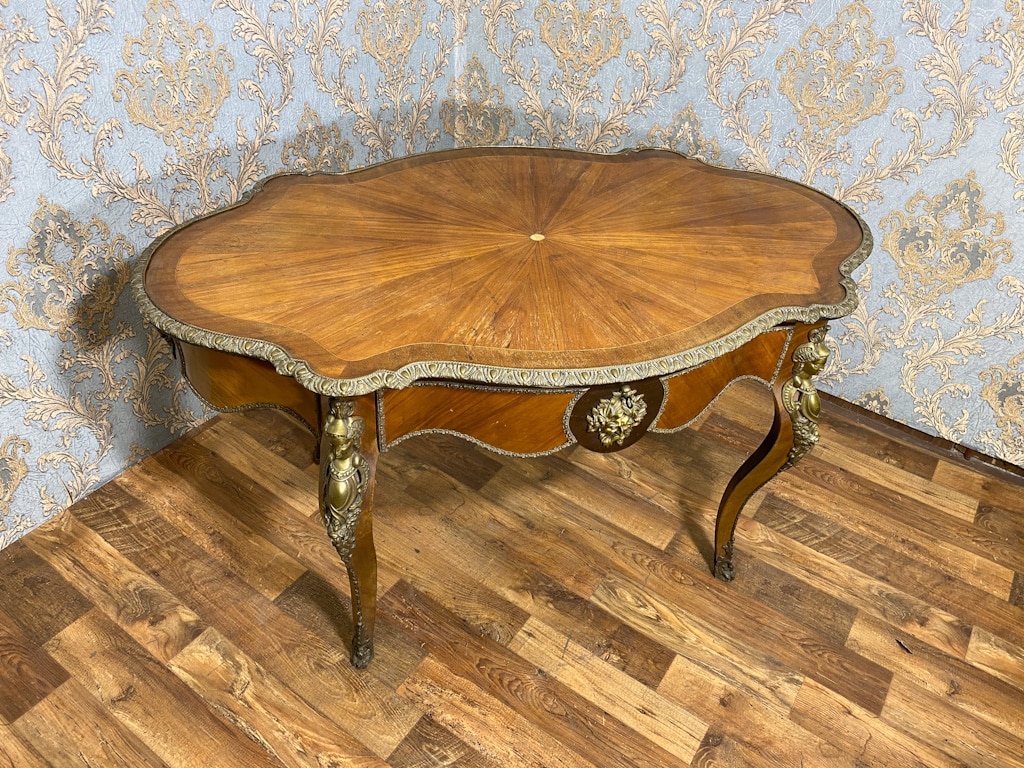
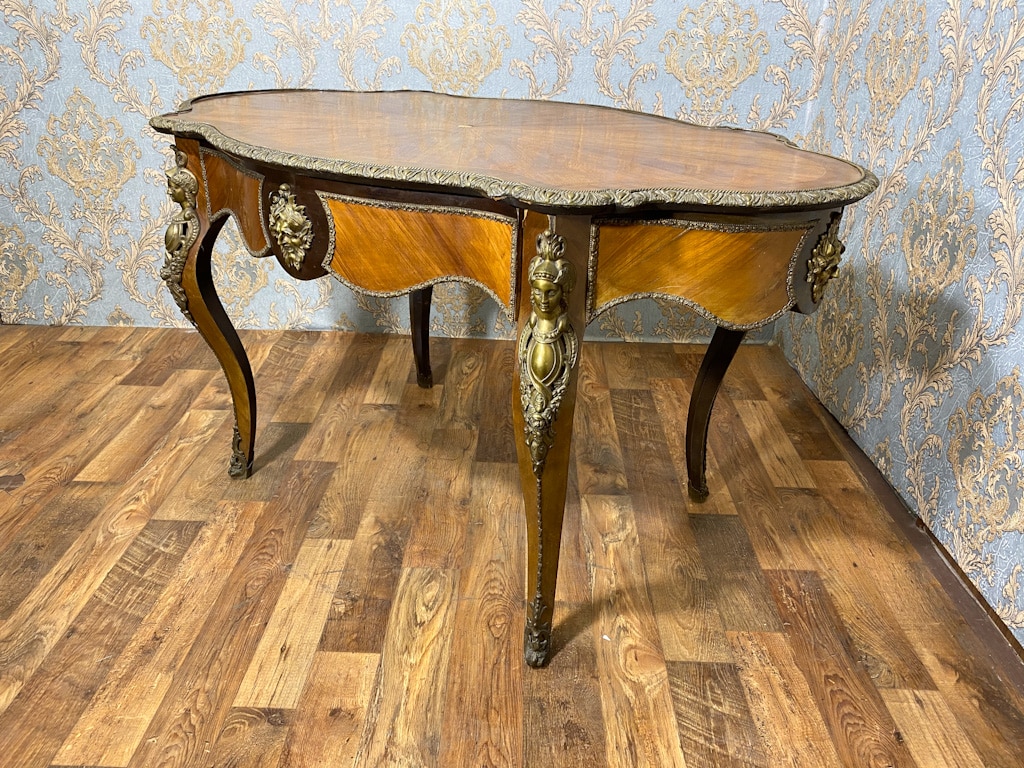
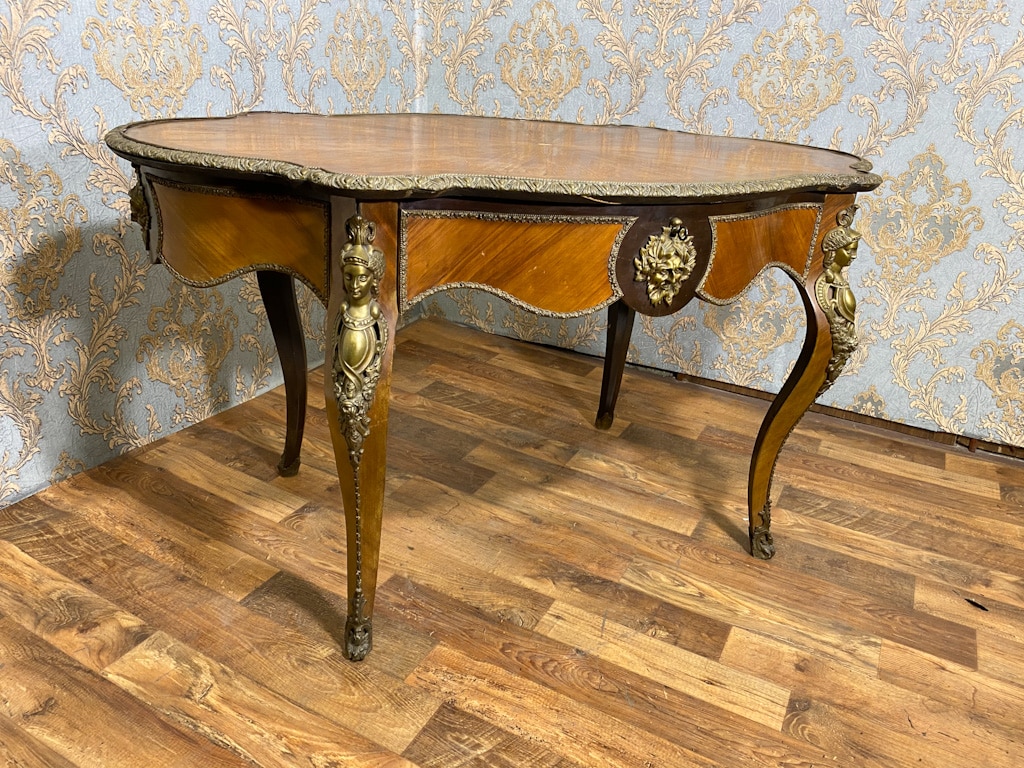
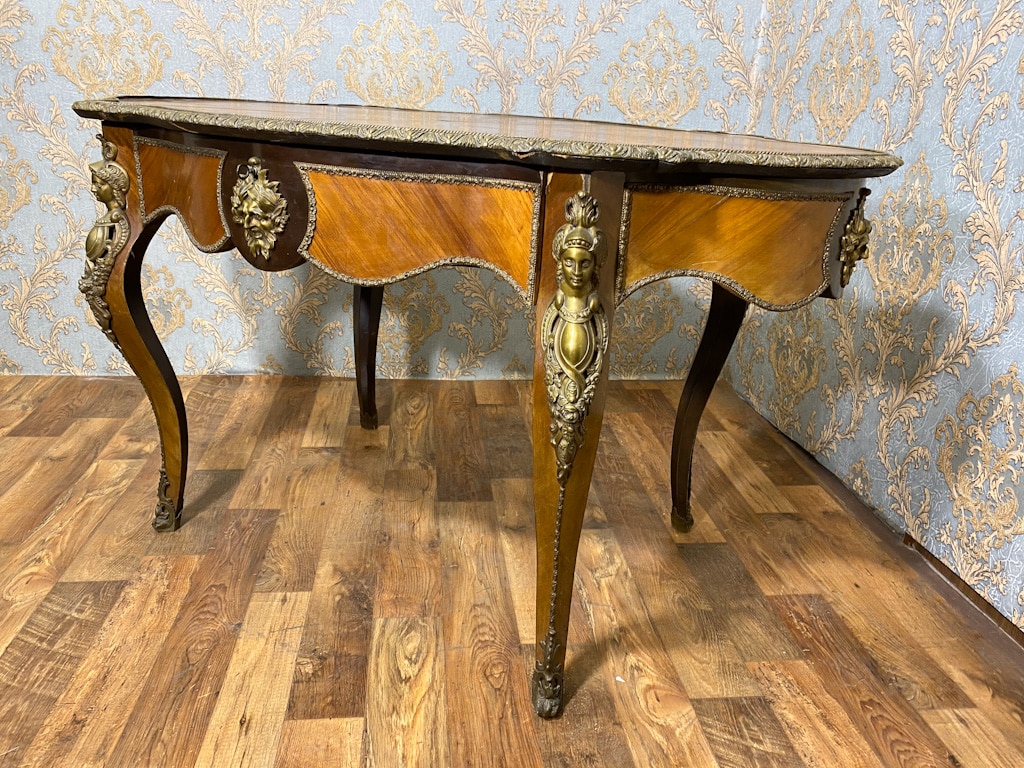
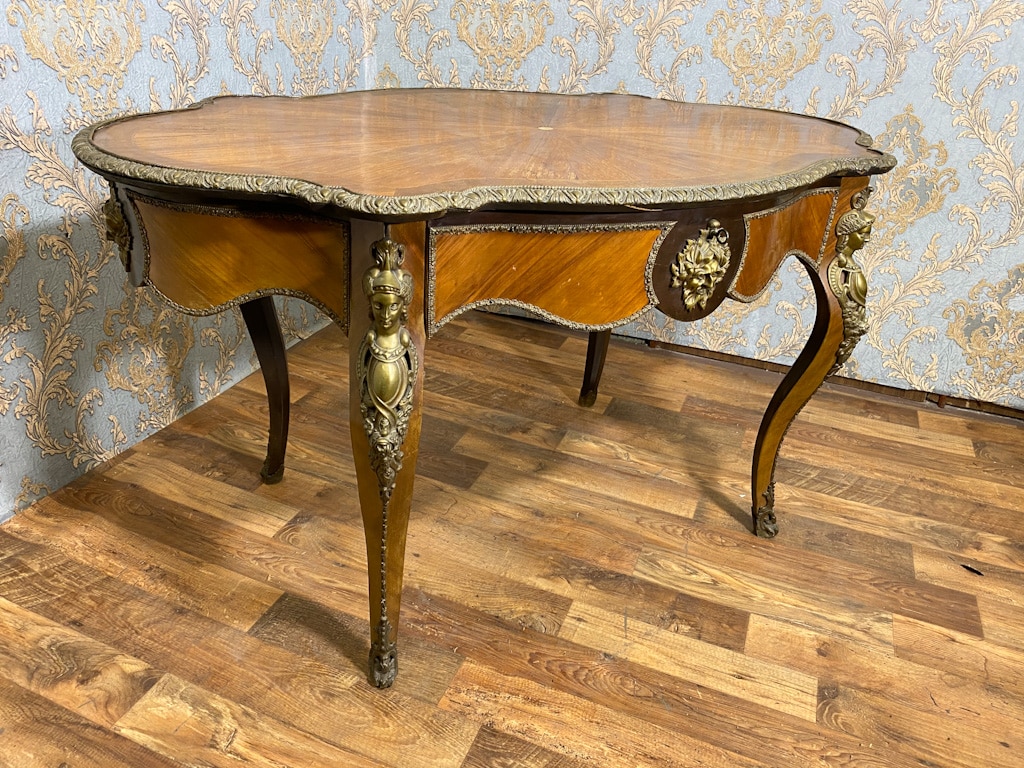
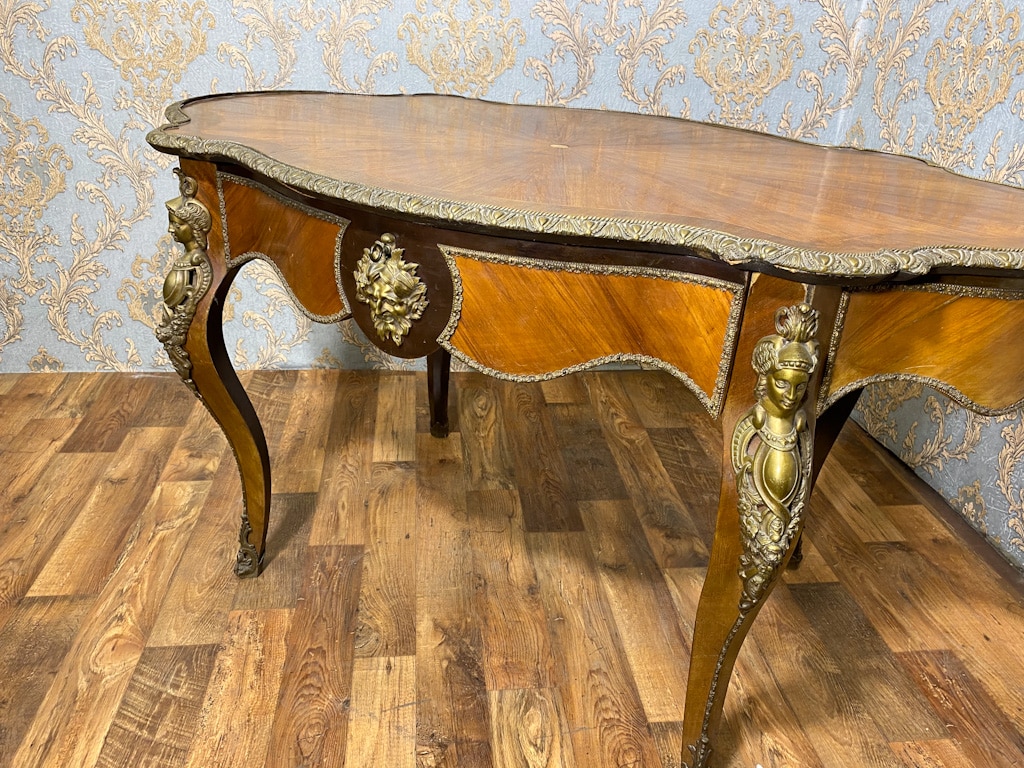
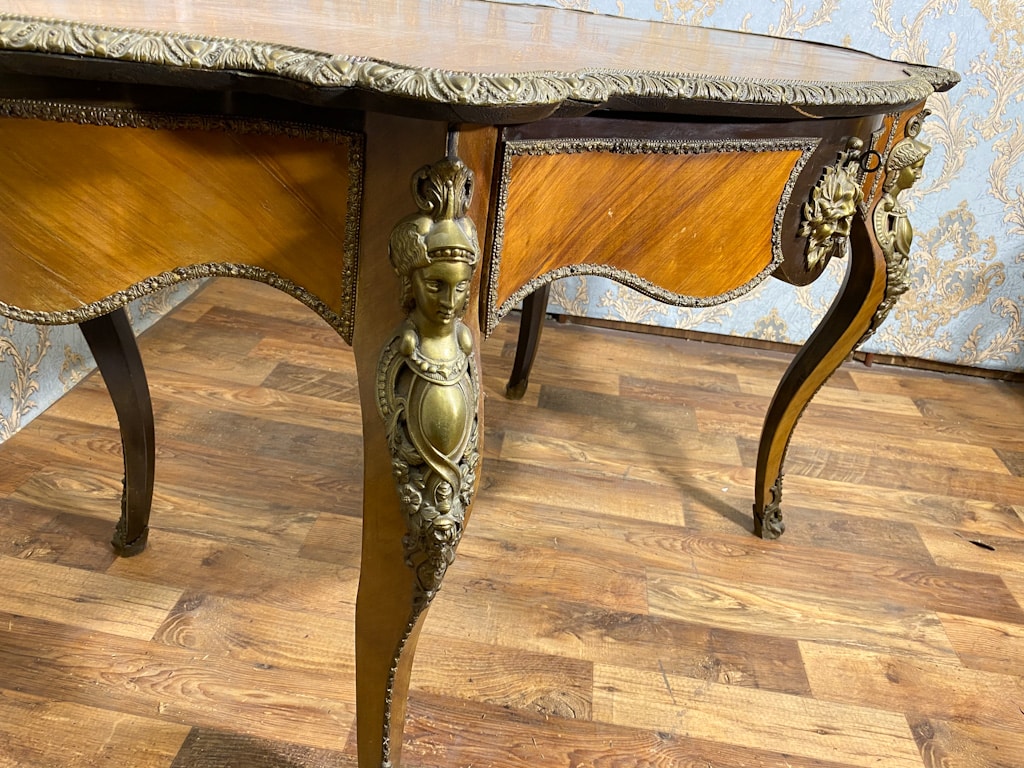
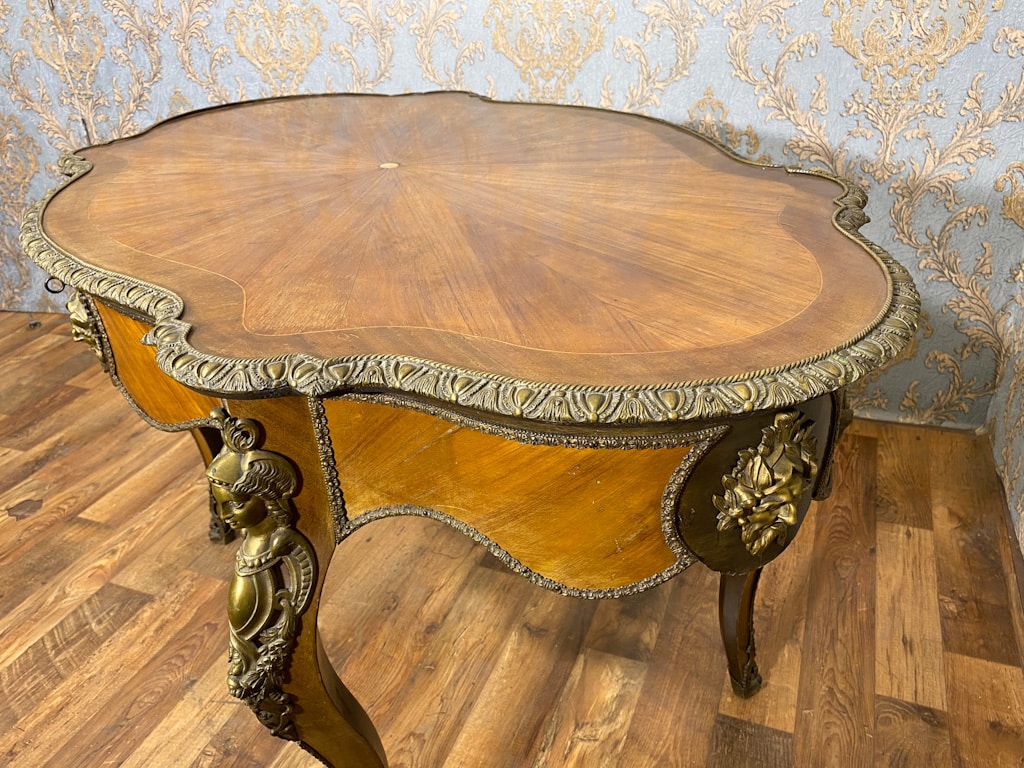
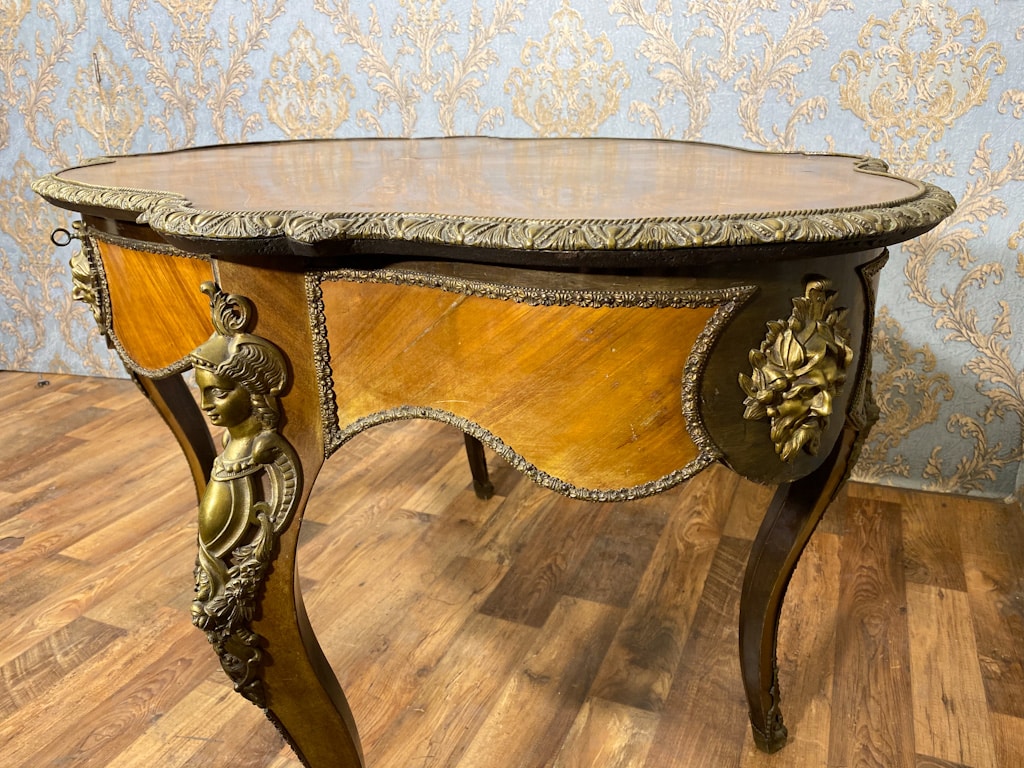
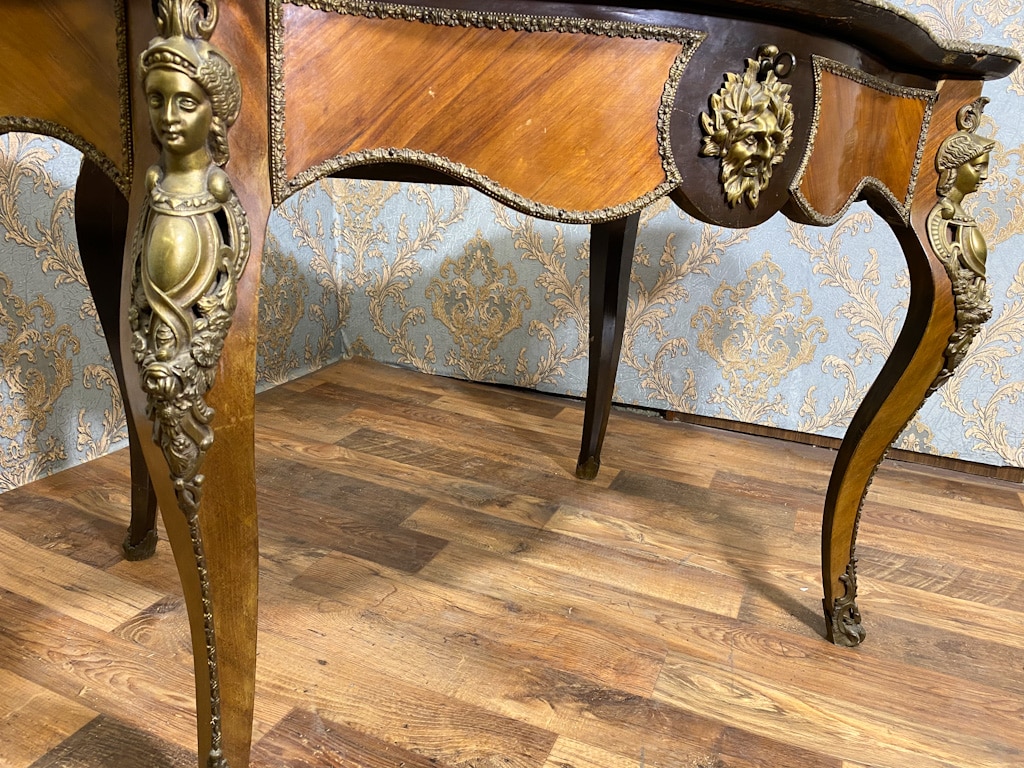
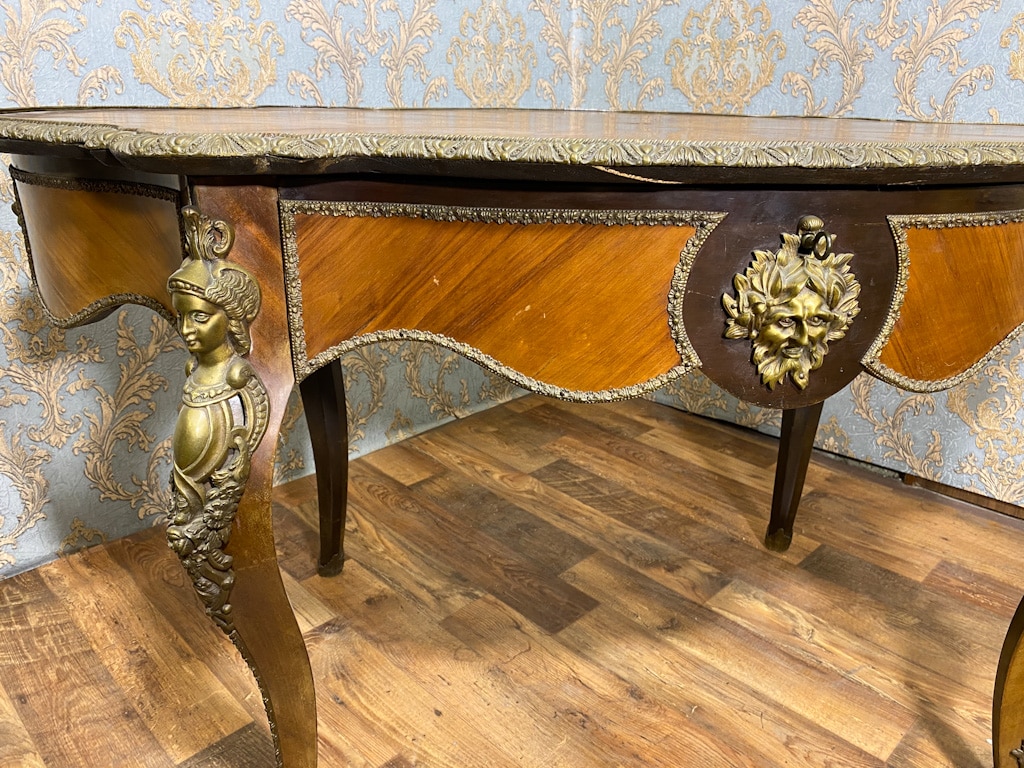
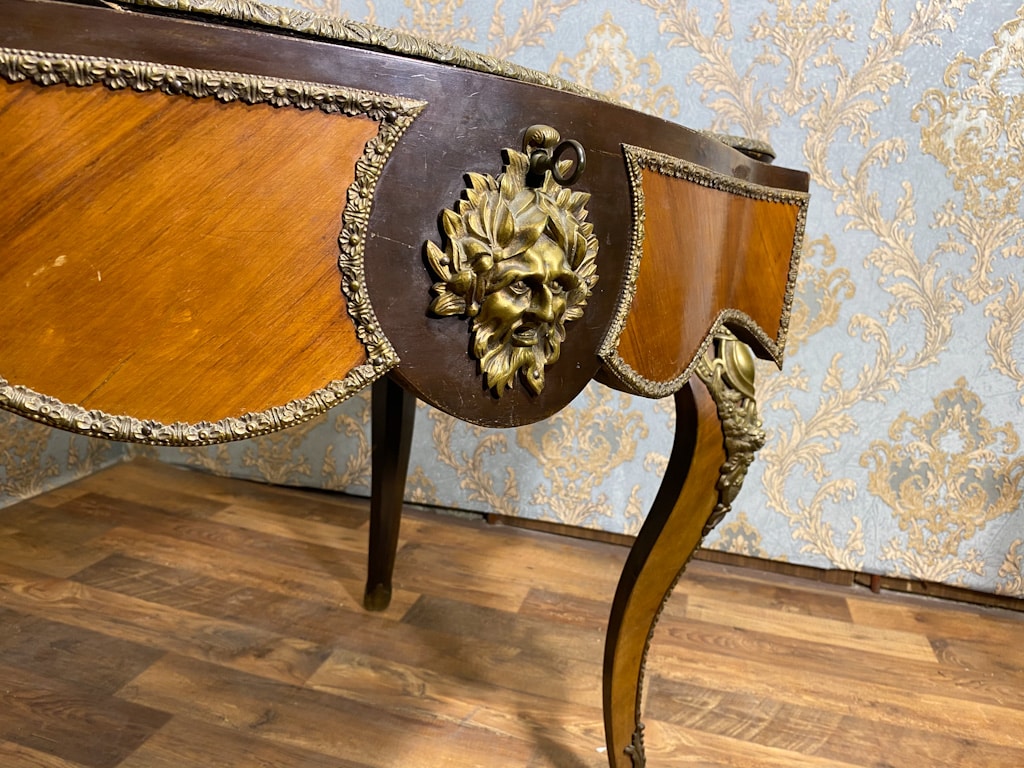
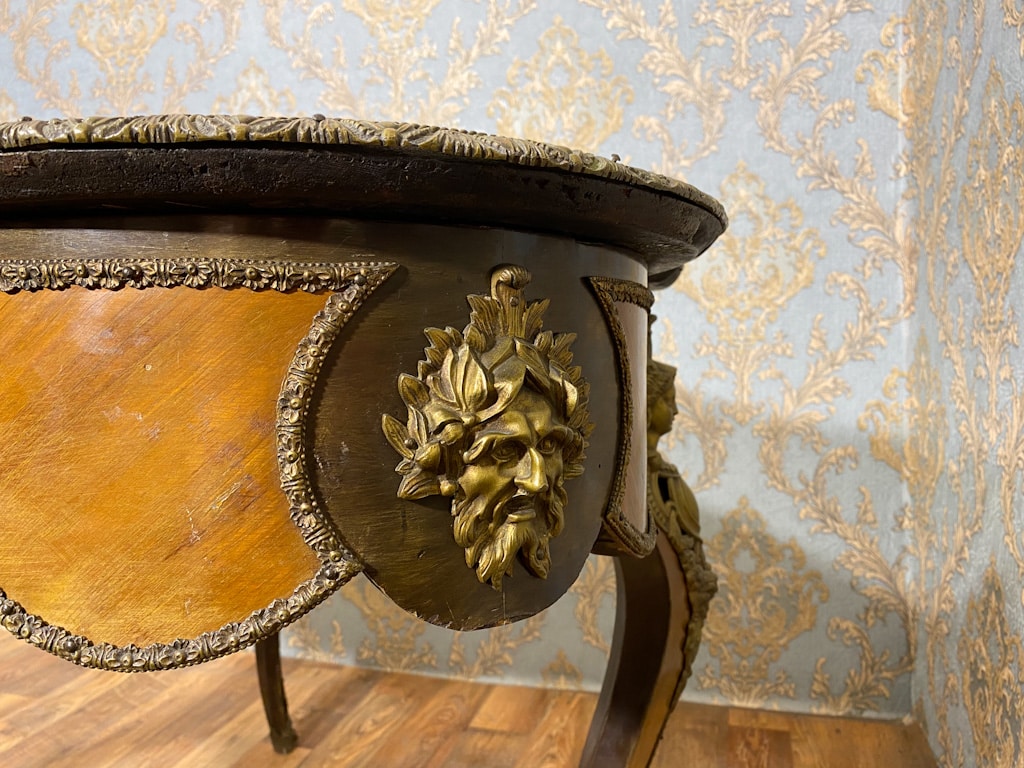
Ovāls rakstāmgalds rozīta finierējumā ar saules staru rakstu, perlamutra centru, bronzas hermès figūriņām kājās un mascaron frīzē. Luja XV / Napoleona III stils, Francija, ap 1860–1880. Aug. 77 × gar. 140 × plat. 86 cm.
Augstums 77 cm × Garums 140 cm × Platums 86 cm
Rakstāmgalds — Luja XV / Napoleona III stils, Francija, ap 1860–1880 (571)
Luja XV / Napoleona III stils. Francija. Aptuveni 1860–1880.
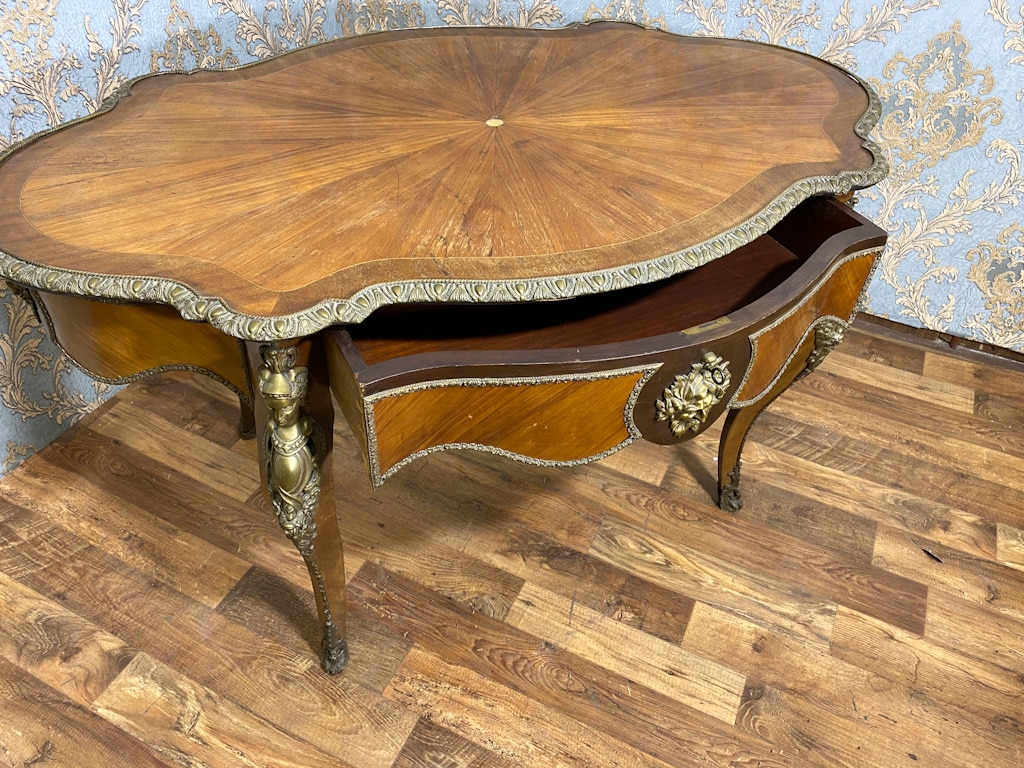
Ārkārtīgi izsmalcināts ovālais rakstāmgalds (table de milieu) rozīta (bois de rose) un augļukoka finierējumā ar saules staru (rayonnant) rakstu un perlamutra centrālo akcentu — viens no elegantākajiem un vizuāli bagātākajiem Napoleona III laikmeta galdniecības piemēriem, kas apvienoja Luja XV rokokō brīvību ar sava laika tehnoloģiskajām iespējām un dekoratīvo ambīciju. Galda virsmas serpentine kontūra — viļņota, ar izteiktiem ieliektās formas pagriezieniem — ir izpildīta ar matemātisku precizitāti; visi finierējuma šķiedru virzieni no centra plūst uz āru kā saules stari, savienojoties perlamutra aplī. Šāds efekts prasa meistara roku un daudzu stundu darbu.
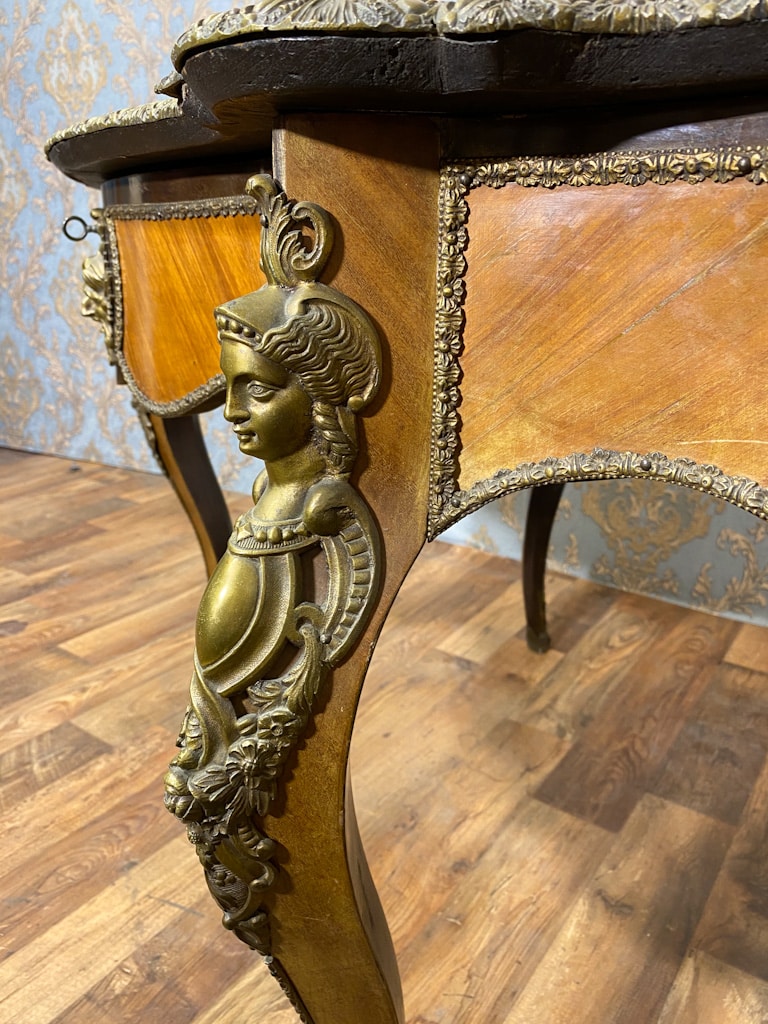
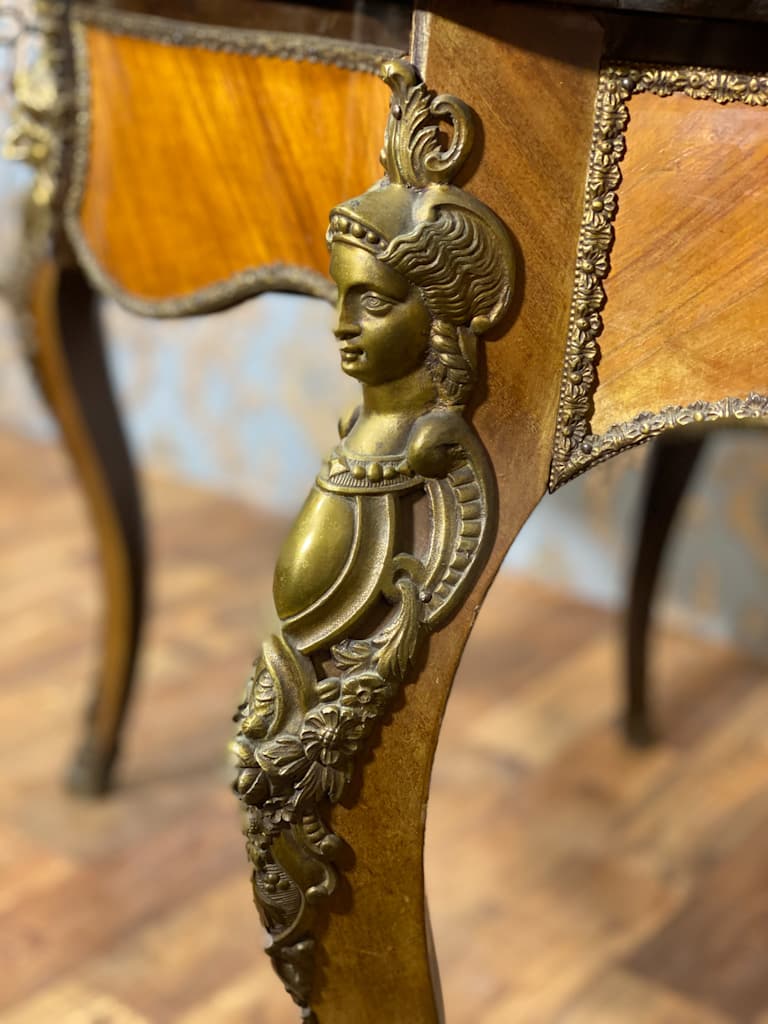
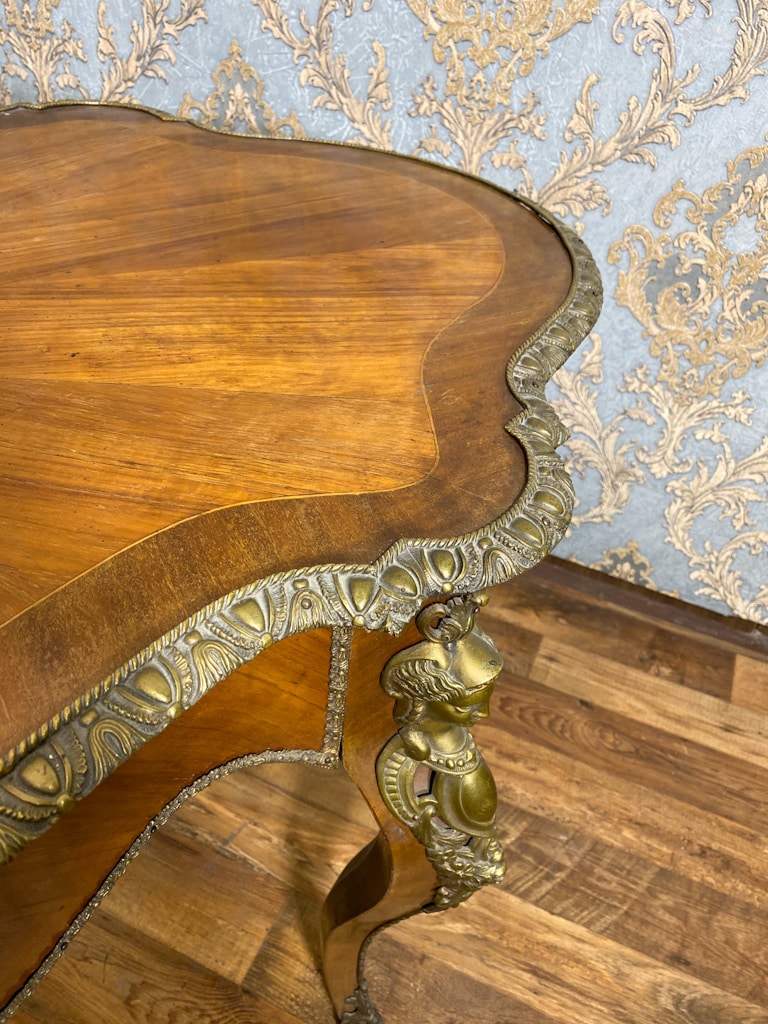
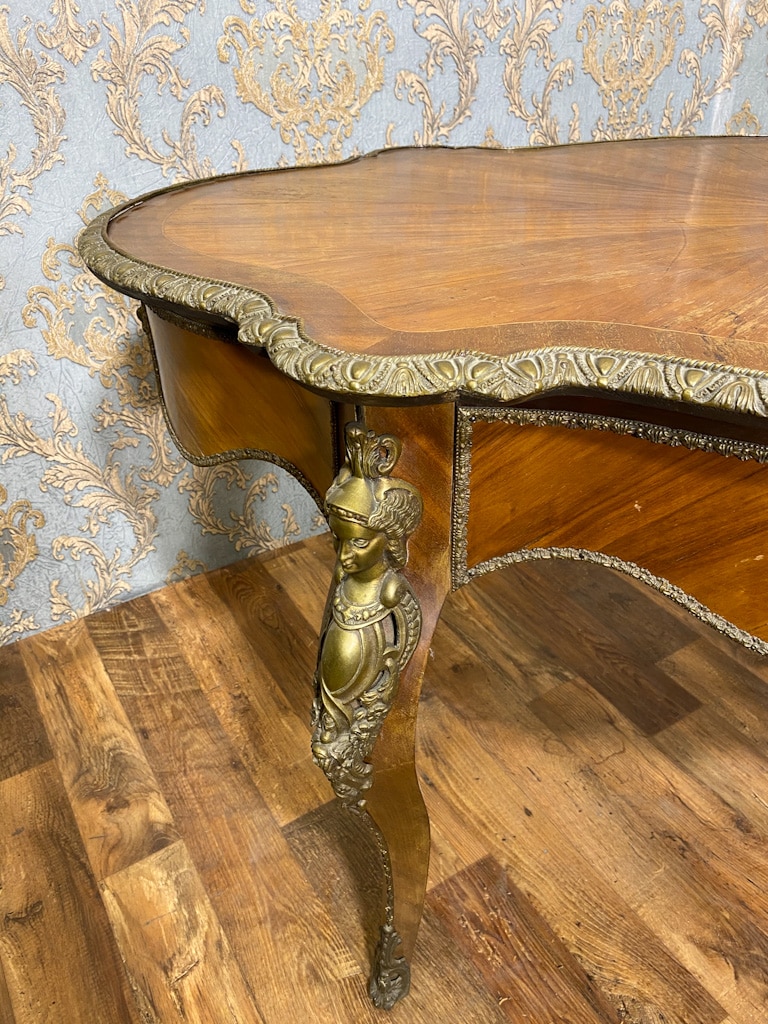
Galda malu ieskauj plata bronzas ormolu apmale ar oeuf-et-dard — olu un bultiņu — jostu, kas ir viens no Romas klasicisma senākajiem un iecienītākajiem motīviem. Apakšā frīzē — viena atvilktne ar bronzas gadroon apmali. Centrālais frīža mascaron — bārdains vīrieša profils lauru lapas vainagā, ko ieskauj akantus vīteņi — identificējams kā Neptūns vai Bakhuss, divi Napoleona III laikmeta dekoratīvās programmas iecienīti motīvi. Četras cabriole kājas ar izliektu S-formas profilu aprīkotas ar masīvām bronzas hermès figūriņām — sieviešu sejas ar diadēmu galvā un krūšu torss, no kura plūst lapu vīteņi. Kāju augšdaļā papildus — mazas putti figūriņas ar spārniem. Kājas noslēdzas bronzas sabots ar maziem riteņveida elementiem.
🇱🇻 Napoleona III laikmeta momentuzņēmums: Parīzē, 1867. gada jūnijā, rakstniece Žorža Sanda (George Sand) bija ieradusies Pasaules izstādē uz vienu dienu. Pēc tam viņa atgriezās savā viesnīcas numurā un sēdēja pie galda pie loga. Vienu brīdi viņas roka apstājās uz perlamutra — aukstā, gludā, nedaudz mitrā no vakara gaisa. Viņa neko nerakstīja. Bet roka palika tur vēl brīdi.
Ražotājs un marķējums. Zīmogs nav redzams fotogrāfijās. Saules staru finierējuma precizitāte, bronzas hermès figūriņu kvalitāte un ormolu apmales dziļums norāda uz vadošo Parīzes galdniecības darbnīcu, kas strādāja Napoleona III uzplaukuma periodā. Šāda tipa ovālie galdi ar hermès figūriņām kājās un mascaron frīzē ir identificējami kā augstākās klases ébénisterie parisienne — salīdzināmi ar Linkes, Dasson un citu laikmeta meistaru produkciju.
Retums un nozīme. Ovālie galdi ar saules staru finierējumu, perlamutra centru un pilnu bronzas hermès un mascaron programmu ir ļoti reti antikvāru tirgū. Perlamutra aplī centrā ir ārkārtīgi rets elements — tas paaugstina šo galdu virs standarta table de milieu kategorijas uz individuāla pasūtījuma līmeni. Šādi galdi aktīvi tiek meklēti gan Parīzes, gan Londonas un Ņujorkas aukcionos.
Pielietojums interjerā, dizainā un fotogrāfijā. Galds ir paredzēts reprezentatīvai viesistabai vai salonam ar augstiem griestiem — kā centrālais akcentu galds, kā rakstāmgalds vai kā dekoratīvs izstādes galds skulptūrām un kompozīcijām. Tā ovālā forma un bronzas programma padara to par izcilu fotogrāfiju fona mēbeli modes, juvelierizstrādājumu un luksusa produktu uzņēmumiem.
Stāvoklis. Finierējums labā vispārējā stāvoklī ar dabīgu laika patinu. Perlamutra centrs neskaits. Bronzas aplikācijas — ar laika patinu, bez būtiskiem bojājumiem. Atvilktne darbojas. Lietas stāvoklis pilnībā atspoguļots fotogrāfijās.
🇷🇺
Высота 77 см × Длина 140 см × Ширина 86 см
Письменный стол — Стиль Людовика XV / Наполеона III, Франция, около 1860–1880 гг. (571)
Стиль Людовика XV / Наполеона III. Франция. Около 1860–1880 гг.
Исключительно изысканный овальный письменный стол (table de milieu) в шпоне из bois de rose и фруктового дерева с рисунком солнечных лучей (rayonnant) и центральным акцентом из перламутра — один из наиболее элегантных и визуально богатых образцов мебельного искусства эпохи Наполеона III, сочетавшего свободу рококо Людовика XV с технологическими возможностями и декоративными амбициями своего времени. Serpentine-контур столешницы — волнистый, с выраженными вогнутыми поворотами — выполнен с математической точностью; все направления волокон шпона расходятся от центра как солнечные лучи, сходясь в круге из перламутра. Такой эффект требует руки мастера и многих часов работы.
Края стола охватывает широкая бронзовая ormolu-кромка с поясом oeuf-et-dard — орнаментом «яйцо и дротик» — одним из древнейших и любимейших мотивов римского классицизма. В фризе — один ящик с бронзовым обрамлением. Центральный mascaron фриза — бородатый мужской профиль в лавровом венке, окружённый акантовыми гирляндами — идентифицируется как Нептун или Вакх. Четыре ножки cabriole оснащены массивными бронзовыми фигурками hermès — женские лица в диадеме и торс, из которого ниспадают листовые гирлянды. В верхней части ножек — малые крылатые фигурки putti. Ножки завершаются бронзовыми sabots.
🇷🇺 Снимок эпохи Наполеона III: В Париже, в июне 1867 года, писательница Жорж Санд (George Sand) приезжала на Всемирную выставку на один день. После этого она вернулась в свой номер в гостинице и сидела за столом у окна. На мгновение её рука остановилась на перламутре — холодном, гладком, чуть влажном от вечернего воздуха. Она ничего не написала. Но рука оставалась там ещё немного.
Производитель и маркировка. Клеймо на фотографиях не обнаружено. Точность шпона с солнечными лучами, качество бронзовых фигурок hermès и глубина ormolu-кромки указывают на ведущие парижские мастерские периода расцвета Наполеона III, сопоставимые с продукцией Линке, Дассона и других мастеров эпохи.
Редкость и значимость. Овальные столы с шпоном солнечных лучей, центром из перламутра и полной бронзовой программой из hermès и mascaron исключительно редки на антикварном рынке. Центральный круг из перламутра является крайне редким элементом, поднимающим этот стол на уровень индивидуального заказа.
Применение в интерьере, дизайне и фотографии. Стол предназначен для представительной гостиной или салона с высокими потолками. Для фотографов — превосходный фоновый предмет для съёмок моды, ювелирных украшений и предметов роскоши.
Состояние. Шпон в хорошем общем состоянии с естественной патиной. Перламутровый центр не повреждён. Бронзовые накладки с патиной времени, без существенных повреждений. Ящик функционирует. Состояние предмета полностью отражено на фотографиях.
🇬🇧
Height 77 cm × Length 140 cm × Width 86 cm
Writing Table — Louis XV / Napoleon III Style, France, circa 1860–1880 (571)
Louis XV / Napoleon III style. France. Circa 1860–1880.
An exceptionally refined oval writing table (table de milieu) in bois de rose and fruitwood veneer with a sunburst (rayonnant) pattern and a central mother-of-pearl accent — one of the most elegant and visually rich examples of Napoleon III cabinetmaking, uniting the freedom of Louis XV rococo with the technical ambition of its own era. The serpentine contour of the top — undulating, with pronounced concave turns — is executed with mathematical precision; all veneer grain directions flow outward from the centre like sunrays, converging at a circle of mother-of-pearl inlay. Such an effect demands a master hand and many hours of work.
The table edge is encircled by a broad ormolu bronze border with an oeuf-et-dard — egg-and-dart — frieze, one of the oldest and most beloved ornamental motifs of Roman classicism. The apron carries a single drawer with a bronze gadroon border. The central frieze mascaron — a bearded male face in a laurel wreath surrounded by acanthus garlands — is identifiable as Neptune or Bacchus, two beloved motifs of the Napoleon III decorative programme. The four cabriole legs are fitted with massive bronze hermès figures — female faces with diadems above a torso from which leaf garlands descend. At the upper leg, additional small winged putti figures. The legs terminate in bronze sabots with small scroll elements.
🇬🇧 Napoleon III era snapshot: In Paris, in June 1867, the writer George Sand (George Sand) had come to the World’s Fair for a single day. Afterwards she returned to her hotel room and sat at the table by the window. For a moment her hand stopped on the mother-of-pearl — cool, smooth, faintly damp from the evening air. She wrote nothing. But her hand stayed there a little longer.
Maker and marks. No maker’s mark is visible in the photographs. The precision of the sunburst veneer, the quality of the bronze hermès figures, and the depth of the ormolu border point to the leading Parisian ateliers of the Napoleon III period, comparable to the production of Linke, Dasson, and other masters of the era.
Rarity and significance. Oval tables with sunburst veneer, a mother-of-pearl centre, and a full bronze programme of hermès figures and mascarons are exceptionally rare on the antiques market. The central mother-of-pearl inlay is an extraordinarily rare element, raising this table above the standard table de milieu category to the level of an individual commission.
Interior and photographic use. The table demands a representative salon with generous ceiling height — as a central accent table, a writing surface, or a display piece for sculpture and decorative compositions. Its oval form and bronze programme make it outstanding for fashion, jewellery, and luxury product photography.
Condition. The veneer is in good overall condition with natural aged patina. The mother-of-pearl centre is undamaged. The bronze mounts show aged patina without significant damage. The drawer functions. The condition of the item is fully reflected in the photographs.
🇩🇪
Höhe 77 cm × Länge 140 cm × Breite 86 cm
Schreibtisch — Louis-XV-Stil / Napoleon-III-Stil, Frankreich, um 1860–1880 (571)
Louis-XV-Stil / Napoleon-III-Stil. Frankreich. Um 1860–1880.
Ein außergewöhnlich raffinierter ovaler Schreibtisch (table de milieu) in bois de rose– und Obstholzfurnier mit Sonnenstrahlen-Muster (rayonnant) und einem zentralen Perlmuttakzent — eines der elegantesten und visuell reichsten Beispiele der Möbelkunst der Napoleon-III-Ära, das die Freiheit des Louis-XV-Rokoko mit den technologischen Möglichkeiten und dekorativen Ambitionen seiner eigenen Zeit verband. Die Serpentine-Kontur der Platte ist mit mathematischer Präzision ausgeführt; alle Furnierfasern verlaufen vom Zentrum strahlenförmig nach außen und treffen sich in einem Perlmuttkreis. Der Tischrand ist von einer breiten Ormolu-Bronzeleiste mit Oeuf-et-dard-Fries umfasst. Das zentrale Mascaron — ein bärtiges Männergesicht im Lorbeerkranz, identifizierbar als Neptun oder Bacchus — ist von Akanthusgirlanden umgeben. Die vier Cabriole-Beine sind mit massiven bronzenen Hermès-Figürchen ausgestattet — Frauengesichter mit Diademen über einem Torso mit herabfließenden Blattgirlanden. An den Beinen zusätzlich kleine geflügelte Putti-Figürchen.
🇩🇪 Momentaufnahme der Napoleon-III-Zeit: In Paris, im Juni 1867, war die Schriftstellerin George Sand (George Sand) für einen Tag zur Weltausstellung gekommen. Danach kehrte sie in ihr Hotelzimmer zurück und saß am Tisch am Fenster. Für einen Moment blieb ihre Hand auf dem Perlmutt — kühl, glatt, vom Abendwind leicht feucht. Sie schrieb nichts. Aber ihre Hand blieb noch eine Weile dort.
Hersteller und Marken. Kein Herstellerstempel erkennbar. Qualität und Ausführung weisen auf führende Pariser Ateliers der Napoleon-III-Hochphase hin, vergleichbar mit der Produktion von Linke, Dasson und anderen Meistern der Ära.
Seltenheit und Bedeutung. Ovale Tische mit Sonnenstrahlen-Furnier, Perlmuttzentrum und vollständiger Bronze-Hermès-und-Mascaron-Ausstattung sind auf dem Antiquitätenmarkt außerordentlich selten. Das zentrale Perlmutteinlagemedaillon ist ein extrem seltenes Element.
Verwendung in Interieur und Fotografie. Der Tisch eignet sich für einen repräsentativen Salon. Für Fotografen ein hervorragendes Requisit für Mode-, Schmuck- und Luxusgüteraufnahmen.
Zustand. Furnier in gutem Allgemeinzustand. Perlmuttzentrum unbeschädigt. Bronzebeschläge mit Alterspatina. Schublade funktioniert. Der Zustand des Objekts ist vollständig in den Fotografien dokumentiert.
🇫🇷
Hauteur 77 cm × Longueur 140 cm × Largeur 86 cm
Table de milieu — Style Louis XV / Napoléon III, France, vers 1860–1880 (571)
Style Louis XV / Napoléon III. France. Vers 1860–1880.
Une exceptionnellement raffinée table de milieu ovale en placage de bois de rose et bois fruitier avec un motif en rayonnant et un accent central en nacre — l’un des exemples les plus élégants et visuellement riches de l’ébénisterie de l’ère Napoléon III, unissant la liberté du rococo Louis XV aux ambitions techniques et décoratives de son époque. Le contour serpentine du plateau est exécuté avec une précision mathématique ; toutes les directions des fibres du placage rayonnent du centre vers l’extérieur, convergeant dans un cercle de nacre. Le bord est encerclé par une large bordure en bronze ormolu avec une frise oeuf-et-dard. Le mascaron central — un visage masculin barbu en couronne de lauriers, identifiable comme Neptune ou Bacchus — est entouré de rinceaux d’acanthe. Les quatre pieds cabriole sont garnis de massives figurines hermès en bronze — visages féminins avec diadèmes au-dessus d’un torse d’où descendent des guirlandes de feuilles. Des petites figurines ailées putti ornent la partie supérieure des pieds.
🇫🇷 Instantané de l’époque Napoléon III : À Paris, en juin 1867, l’écrivaine George Sand (George Sand) était venue à l’Exposition universelle pour une seule journée. Ensuite elle regagna sa chambre d’hôtel et s’assit à la table près de la fenêtre. Un instant, sa main s’arrêta sur la nacre — fraîche, lisse, légèrement humide de l’air du soir. Elle n’écrivit rien. Mais sa main resta là encore un moment.
Fabricant et marques. Aucun poinçon visible. La qualité indique les principaux ateliers parisiens de la haute période Napoléon III, comparables à la production de Linke, Dasson et d’autres maîtres de l’époque.
Rareté et importance. Les tables ovales avec placage en rayonnant, centre en nacre et programme bronze complet sont exceptionnellement rares sur le marché des antiquités. L’incrustation centrale en nacre est un élément extraordinairement rare.
Utilisation en décoration et photographie. La table convient à un salon représentatif. Pour les photographes, un accessoire remarquable pour des prises de vue mode, joaillerie et luxe.
État. Placage en bon état général. Centre en nacre intact. Appliques en bronze avec patine. Tiroir fonctionnel. L’état de la pièce est entièrement reflété dans les photographies.