Antīka Bombé Kumode ar Mascaron Bronzu un Marmora Virsmu — Luija XV, Francija, 18.gs. (4136)



Antīka Bombé Kumode ar Mascaron Bronzu un Marmora Virsmu — Luija XV, Francija, 18.gs. (4136)
€2,200.00
IZMĒRI
Augstums: 81 cm × Garums: 122 cm × Dziļums: 59 cm. Svars: ļoti smags (masīvs koks, bronza, marmors).
Antīka Trīs Atvilktņu Bombé Kumode ar Parquetry Furnieri, Bronzas Mascaron Furnitūru un Marmora Virsmu — Luija XV stils, Francija, ap 1740.–1770.
IZGATAVOŠANAS PERIODS, MĀKSLAS STILS, LAIKMETS
Šī trīs atvilktņu bombé kumode ir viens no iespaidīgākajiem Luija XV stila paraugiem, kas nonācis savā oriģinālajā, nerestaurētajā stāvoklī — ar autentisku sarkankoka parquetry furnieri, masīvām bronzas mascaron stūra montāžām un oriģinālu, sarežģītā toņu struktūrā krāsotu marmora virsmu. Luija XV bombé commode ar trīs atvilktnēm — à trois tiroirs — bija 18. gadsimta franču galdniecības augstākās klases sasniegums, un tieši šāda konstruktīvā forma ar izteiktu sānu un priekšpuses izliekumu ir raksturīga 1740.–1760. gadu Parīzes ébénistes darbiem.
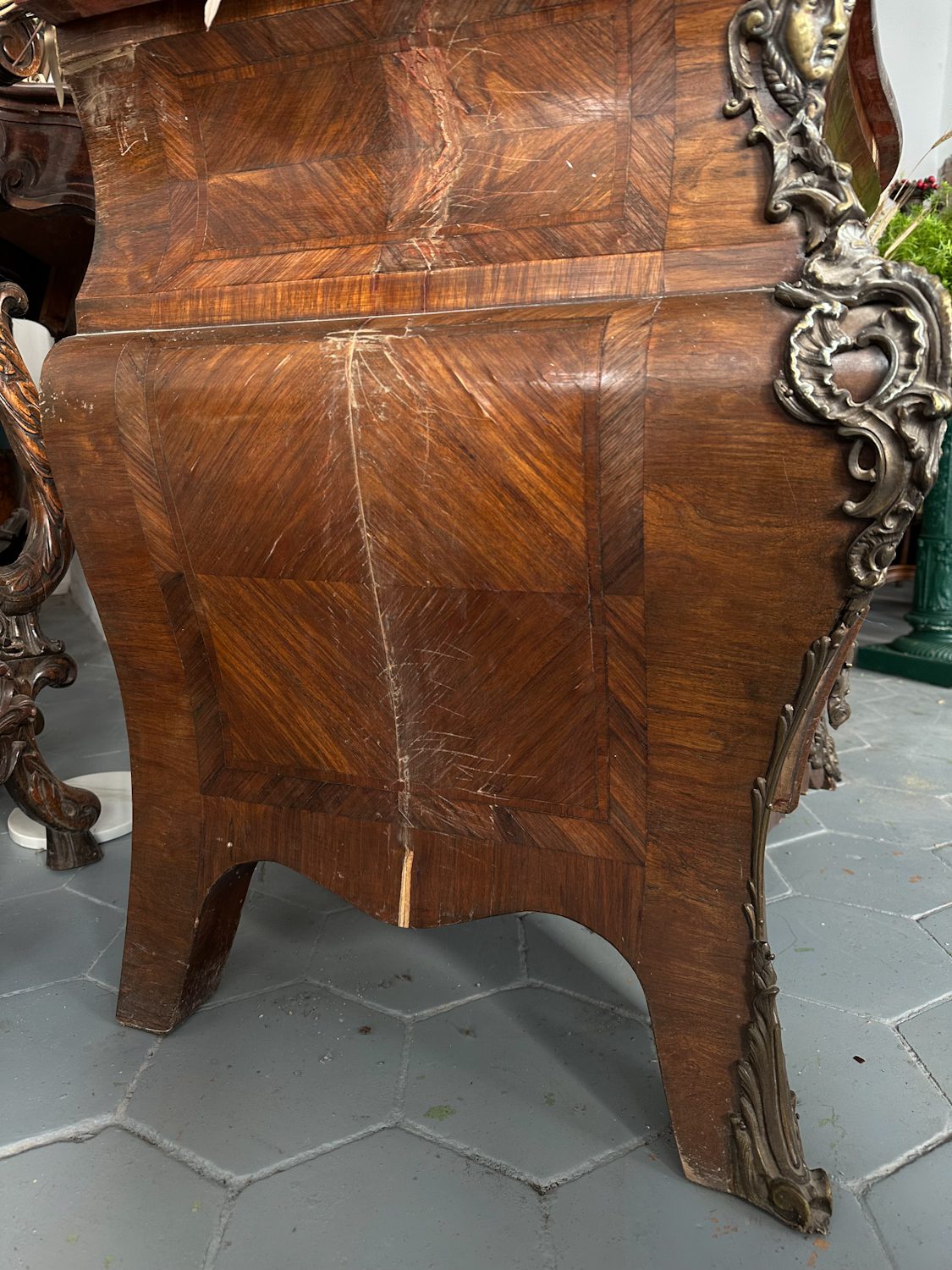
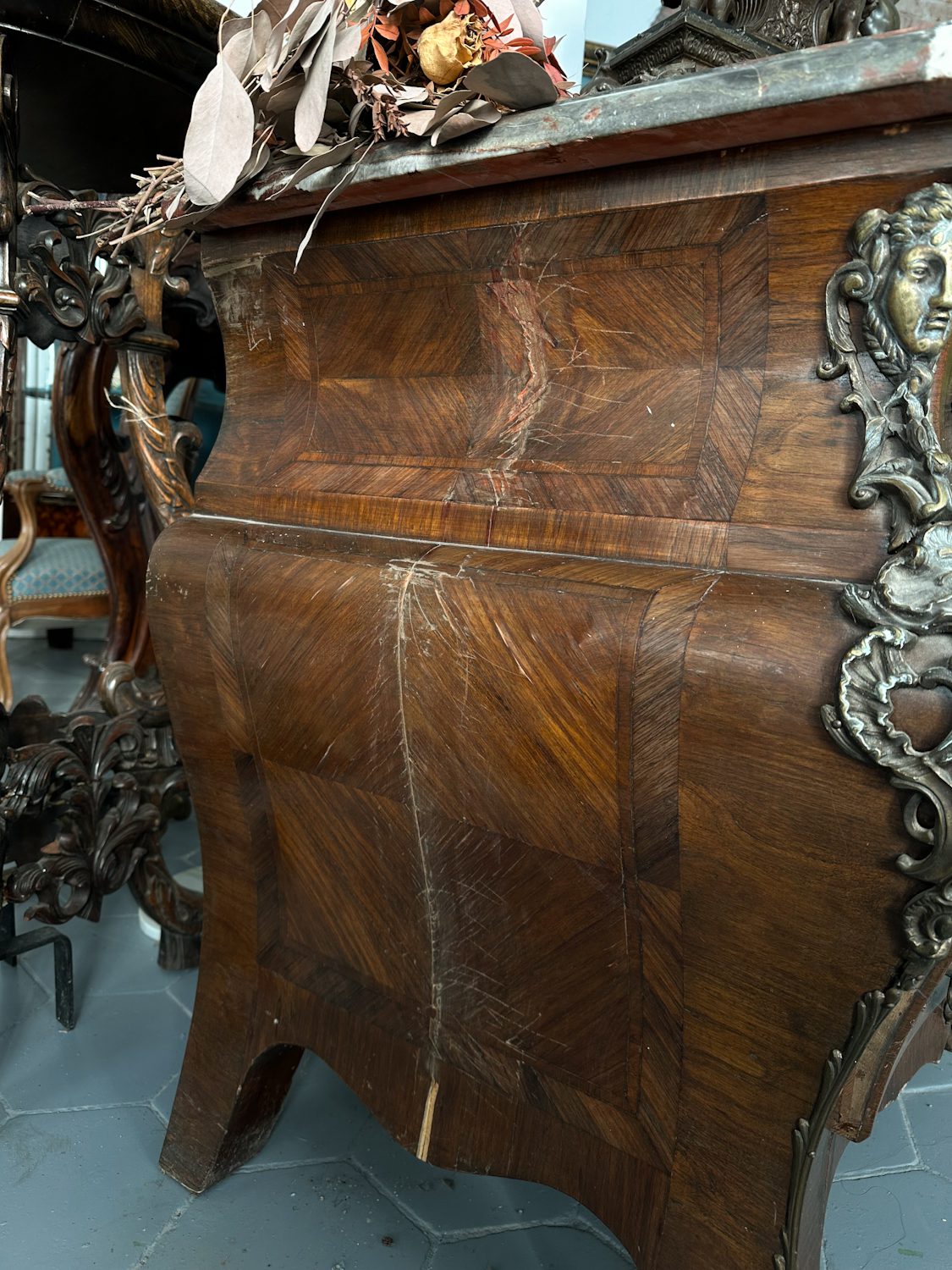
Fasādes parquetry — sarkankoka un gaišākas koksnes rombu un dimantu raksts — ir veikts ar augstu precizitāti. Katras atvilktnes rokturu appliqués ir masīvi lieti bronzā ar rocaille lapu motīviem. Stūra mascaron montāžas — ar sieviešu seju un lapu vainaga ikonografiju — ir lieliskas plastiskuma un detaļu ziņā, raksturīgas augstākā līmeņa Parīzes fondeur-ciseleur darbam. Lejasdaļas tablier ar centrālo rocaille cartouche un kāju sabots ar lapu ornamentu noslēdz kompozīciju klasiskā Luija XV proporcionālajā valodā. Marmora virsma — pelēks ar sarkaniem un baltiem žilbu vijumiem, iespējams Griotte de Flandre vai Lumachelle tipa marmors — ir ārkārtīgi raksturīga tieši 18. gadsimta Francijas augstākās klases kumodu virsmām.
Šī kumode datējama ar aptuveni 1740.–1770. gadu — īsto Luija XV stila ziedu laiku, pirms Belle Époque un pirms Neoklasicisma revolūcijas, kad Parīzes ébénistes radīja formas, kas vēlāk kļuva par visu Eiropas galdniecības tradīciju pamatu.
Belle Époque momentuzņēmums: Kad 1882. gadā Edmond de Goncourt Parīzē organizēja savu slaveno kolekcijas izsoli, tieši šāda veida Luija XV bombé kumodes ar mascaron stūra montāžām sasniedza rekordcenas — un kritiķi rakstīja, ka “18. gadsimta franču ébénisterie ir nesasniedzama virsotne, pie kuras Belle Époque meistari tikai tuvojas.” Šī kumode pastāvēja jau tobrīd — varbūt kādā Parīzes hôtel particulier salonā, varbūt Flandrijas pilī, kur tās marmors ieguva pirmo patinu.
RAŽOTĀJS UN MANUFAKTŪRAS ZĪMOGS
Redzama marķējuma nav — raksturīga parādība 18. gadsimta pirmās puses Parīzes ébénistes darbiem, kuri nemarķēja produkciju pirms 1743. gada obligātā ģildes estampille noteikuma ieviešanas. Pēc mascaron bronzas plastiskuma, parquetry izpildījuma un bombé formas proporcijām — lieta atbilst Parīzes augstākās klases ébéniste darbnīcas stilistikai, iespējams tuva tādiem meistariem kā Pierre Migeon II vai Jacques Dubois, kuri specializējās tieši šāda veida bombé konstruktīvajās formās ar rocaille bronzas furnitūru. Marmora virsma un bronzas toņi norāda uz oriģinālā stāvokļa saglabāšanos — bez vēlākiem aizstājumiem.
RETUMS UN NOZĪME
Autentiska Luija XV perioda bombé kumode ar trīs atvilktnēm, oriģināliem mascaron stūra mounts, parquetry furnieri un oriģinālu marmora virsmu nerestaurētā stāvoklī ir ārkārtīgi reta parādība jebkurā antikvāru tirgū. Lielākajai daļai 18. gadsimta komodu vai nu ir aizstāta marmora virsma, vai nomainīta bronzas furnitūra, vai veiktas koka restaurācijas. Šīs kumodes autentiskums — ar visām vecuma pēdām — padara to par muzeja kategorijas kolekcijas lietu. Luija XV trīs atvilktņu bombé kumode ar mascaron montāžām pieder pie augstākās pieprasījuma kategorijas starptautiskajos izsoles namos.
PIELIETOJUMS INTERJERĀ, DIZAINĀ UN FOTOGRĀFIJĀ
Šī kumode ir radīta reprezentatīviem guļamistabas, salona vai kabineta interjeriem. Tās 122 cm garums un bombé siluets padara to par vizuāli dominējošu lietu jebkurā telpā. Sader ar Luija XV, Luija XVI, Second Empire un eklektiskiem interjeriem. Virs tās dabīgi ievieto spoguli, gleznojumu vai bronzas skulptūru. Interjeru fotogrāfijā un editorial uzņēmumos — nepārprotams 18. gadsimta Parīzes grand salon akcents. Arī nerestaurētā, patinētā stāvoklī tā izskatās kā muzeja eksponāts.
DĀVANA UN PERSONALIZĀCIJA
Šīs kumodes mākslinieciskā vērtība un vēsturiskā autentiskums padara to par izcilu iegādi augstākā līmeņa kolekcijām un luksusa rezidencēm. Tā izsaka ne tikai gaumi, bet arī dziļu izpratni par 18. gadsimta Francijas kultūrvēsturi. Zvaigznāju simbolikā — Svari, Vērsis un Lauva — personas ar izsmalcinātu estētiku un mīlestību pret autentiskiem vēstures objektiem.
STĀVOKLIS
Kumode ir autentiskā, nerestaurētā stāvoklī ar bagātīgu vecuma patinu. Parquetry furnieri ar redzamām vecuma šuvēm un atsevišķiem sīkiem plaisājumiem — normāla parādība 18. gadsimta koksnes kustībai. Sānu paneļi ar nozīmīgākām skrāpējuma pēdām — redzamas fotogrāfijās un godīgi atspoguļo lietas vecumu. Bronzas furnitūra ar tumšu oksidācijas patinu. Marmora virsma ar dabīgiem žilbu vijumiem un atsevišķām skrāpējuma pēdām. Kumode ir struktūrāli stabila. Restaurācija uzlabotu izskatu, bet nav obligāta — patina ir daļa no autentiskuma. Lietas stāvoklis pilnībā atspoguļots fotogrāfijās.
―――――――――――――――――――――
🇬🇧 DESCRIPTION IN ENGLISH
DIMENSIONS
Height: 81 cm × Length: 122 cm × Depth: 59 cm. Weight: very heavy (solid wood, bronze, marble).
Antique Three-Drawer Bombé Commode with Parquetry Veneer, Bronze Mascaron Mounts and Marble Top — Louis XV Style, France, approximately 1740–1770
PERIOD, ARTISTIC STYLE, ERA
This three-drawer bombé commode is one of the most impressive examples of the Louis XV style to have survived in its original, unrestored condition — with authentic rosewood parquetry veneer, massive bronze mascaron corner mounts and an original marble top of complex tonal structure. The Louis XV bombé commode à trois tiroirs was the supreme achievement of 18th-century French cabinetmaking, and this constructive form — with its pronounced lateral and frontal swelling — is characteristic of Parisian ébéniste work of approximately 1740–1760.
The façade parquetry — a rosewood and lighter wood diamond and lozenge pattern — is executed with high precision. The drawer handle appliqués are massively cast in bronze with rocaille leaf motifs. The corner mascaron mounts — depicting female faces with foliate crown iconography — are outstanding in plasticity and detail, characteristic of the finest Parisian fondeur-ciseleur work. The lower tablier with its central rocaille cartouche and the leaf-ornamented leg sabots complete the composition in the classical Louis XV proportional vocabulary. The marble top — grey with red and white vein patterns, consistent with Griotte de Flandre or Lumachelle type marble — is exceptionally characteristic of 18th-century French highest-class commode tops.
This commode is dateable to approximately 1740–1770 — the true flowering of the Louis XV style, before the Belle Époque and before the Neoclassical revolution, when Parisian ébénistes were creating the forms that would later become the foundation of the entire European cabinetmaking tradition.
Belle Époque snapshot: When Edmond de Goncourt organised his celebrated collection sale in Paris in 1882, it was exactly this type of Louis XV bombé commode with mascaron corner mounts that achieved record prices — and critics wrote that “18th-century French ébénisterie is an unattainable summit that Belle Époque masters can only approach.” This commode already existed at that moment — perhaps in a Parisian hôtel particulier salon, perhaps in a Flemish château where its marble acquired its first patina.
MAKER AND MANUFACTORY MARK
No visible maker’s mark is present — a characteristic feature of Parisian ébénistes working in the first half of the 18th century, who did not mark their production before the introduction of the compulsory guild estampille regulation in 1743. Based on the plasticity of the mascaron bronzework, the execution of the parquetry and the proportions of the bombé form, the piece corresponds to the stylistic vocabulary of the highest-class Parisian ébéniste workshop — possibly in the manner of Pierre Migeon II or Jacques Dubois, who specialised in exactly this type of bombé constructive form with rocaille bronze hardware. The marble top and bronze tones indicate original condition — without later replacements.
RARITY AND SIGNIFICANCE
An authentic Louis XV period bombé commode with three drawers, original mascaron corner mounts, parquetry veneer and an original marble top in unrestored condition is an exceptionally rare find in any antiques market. The majority of 18th-century commodes have either a replacement marble top, replaced bronze hardware or wood restoration. The authenticity of this piece — with all its age marks — places it in the museum-category collection tier. A Louis XV three-drawer bombé commode with mascaron mounts belongs to the highest demand category in international auction houses.
USE IN INTERIOR, DESIGN AND PHOTOGRAPHY
This commode was created for representative bedroom, salon or study interiors. Its 122 cm length and bombé silhouette make it the visually dominant piece in any room. It harmonises with Louis XV, Louis XVI, Second Empire and eclectic interiors. A mirror, painting or bronze sculpture naturally sits above it. In interior photography and editorial shoots — an unmistakable 18th-century Parisian grand salon accent. Even in its unrestored, patinated condition it reads as a museum exhibit.
GIFT AND PERSONALISATION
The artistic value and historical authenticity of this commode make it an outstanding acquisition for the highest-level collections and luxury residences. It expresses not only taste but a deep understanding of 18th-century French cultural history. In astrological symbolism — Libra, Taurus and Leo — personalities of refined aesthetic sensibility and a love of authentic historical objects.
CONDITION
The commode is in authentic, unrestored condition with rich age patina. The parquetry veneer shows visible age seams and minor cracks — a normal consequence of 18th-century wood movement. The side panels carry more significant surface marks — visible in the photographs and honestly reflecting the piece’s age. The bronze hardware displays a dark oxidation patina. The marble top retains its natural vein patterns with minor surface marks. The commode is structurally stable. Restoration would improve the appearance but is not obligatory — the patina is part of the authenticity. The condition of the item is fully reflected in the photographs.
―――――――――――――――――――――
🇷🇺 ОПИСАНИЕ НА РУССКОМ
Размеры: Высота: 81 см × Длина: 122 см × Глубина: 59 см. Очень тяжёлый (массивное дерево, бронза, мрамор).
Антикварный комод bombé с тремя ящиками, паркетным шпоном, бронзовыми mascaron и мраморной столешницей — стиль Людовика XV, Франция, около 1740–1770 гг.
Этот трёхящичный комод bombé — один из наиболее впечатляющих образцов стиля Людовика XV, сохранившихся в подлинном, нереставрированном состоянии. Фасад облицован паркетным шпоном из палисандра с узором в виде ромбов. Массивные угловые накладки из литой бронзы в виде mascaron — женских лиц с листовыми венцами — выполнены с исключительным мастерством, характерным для лучших парижских fondeurs-ciseleurs. Мраморная столешница — серая с красными и белыми прожилками, возможно Griotte de Flandre или Lumachelle — является оригинальной и типичной для французских комодов высшего класса XVIII века.
В 1882 году на знаменитом аукционе коллекции Эдмона де Гонкура в Париже именно такие комоды bombé с угловыми mascaron достигали рекордных цен. Происхождение: предположительно мастерская высшего класса в Париже — возможно, в манере Пьера Мижона II или Жака Дюбуа. Состояние подлинное, нереставрированное, с богатой патиной. Состояние предмета полностью отражено на фотографиях.
―――――――――――――――――――――
🇩🇪 BESCHREIBUNG AUF DEUTSCH
Maße: Höhe: 81 cm × Länge: 122 cm × Tiefe: 59 cm. Sehr schwer (Massivholz, Bronze, Marmor).
Antike Bombé-Kommode mit drei Schubladen, Parkettierfurnier, Bronze-Mascaron-Beschlägen und Marmorplatte — Stil Louis XV, Frankreich, circa 1740–1770
Diese dreiteilige Bombé-Kommode ist eines der beeindruckendsten Beispiele des Louis XV-Stils in authentischem, unrestauriertem Zustand. Die Fassade ist mit Parkettierfurnier aus Palisander in einem Rauten- und Rombenmuster belegt. Die massiven Eck-Mascaron-Beschläge aus gegossener Bronze — weibliche Gesichter mit Blätterkronen — sind von außergewöhnlicher Plastizität, charakteristisch für die besten Pariser fondeurs-ciseleurs. Die Marmorplatte — grau mit roten und weißen Adern, möglicherweise Griotte de Flandre oder Lumachelle — ist original und typisch für französische Kommoden höchster Klasse des 18. Jahrhunderts.
Im Jahr 1882 erzielten genau solche Bombé-Kommoden mit Mascaron-Beschlägen auf der berühmten Auktion der Sammlung von Edmond de Goncourt in Paris Rekordpreise. Herkunft: vermutlich Werkstatt höchster Klasse in Paris — möglicherweise im Stil von Pierre Migeon II oder Jacques Dubois. Zustand: authentisch, unrestauriert, mit reicher Patina. Der Zustand des Objekts ist vollständig in den Fotografien dokumentiert.
―――――――――――――――――――――
🇫🇷 DESCRIPTION EN FRANÇAIS
Dimensions : Hauteur : 81 cm × Longueur : 122 cm × Profondeur : 59 cm. Très lourd (bois massif, bronze, marbre).
Commode bombé ancienne à trois tiroirs, placage parquetry, montures mascaron en bronze et plateau de marbre — style Louis XV, France, circa 1740–1770
Cette commode bombé à trois tiroirs est l’un des exemples les plus saisissants du style Louis XV parvenus dans leur état d’origine non restauré. La façade est plaquée d’un parquetry en palissandre et bois clair à motif de losanges. Les imposantes montures d’angle en bronze moulé représentant des mascarons — visages féminins couronnés de feuillages — sont d’une plastique exceptionnelle, caractéristique des meilleurs fondeurs-ciseleurs parisiens. Le plateau de marbre — gris veiné de rouge et de blanc, peut-être Griotte de Flandre ou Lumachelle — est original et typique des commodes françaises de la plus haute catégorie au XVIIIe siècle.
En 1882, lors de la célèbre vente de la collection d’Edmond de Goncourt à Paris, ce type précis de commode bombé à mascarons atteignait des prix records. Origine probable : atelier de première classe à Paris — peut-être dans la manière de Pierre Migeon II ou Jacques Dubois. État authentique, non restauré, avec riche patine. L’état de la pièce est entièrement reflété dans les photographies.